
Lots of interesting abstracts and cases were submitted for TCTAP 2026. Below are the accepted ones after a thorough review by our official reviewers. Don’t miss the opportunity to expand your knowledge!
ABS20251114_0007
The Role of Continuous Positive Airway Pressure Therapy in Patients With Heart Failure and Sleep-Disordered Breathing: A Meta-Analysis
By Haidar Hamzah, Salma Rasyidah, Muhammad Fakhri Eliansyah Putra, Luhur Pribadi , Margono Gatot Suwandi
Presenter
Haidar Hamzah
Authors
Haidar Hamzah1, Salma Rasyidah1, Muhammad Fakhri Eliansyah Putra2, Luhur Pribadi 1, Margono Gatot Suwandi 1
Affiliation
Indonesian Air Force Centre Hospital (RSPAU) dr. S. Hardjolukito, Indonesia1, Faculty of Medicine, Sriwijaya University , Indonesia2
View Study Report
ABS20251114_0007
Mechanical Circulatory Support
The Role of Continuous Positive Airway Pressure Therapy in Patients With Heart Failure and Sleep-Disordered Breathing: A Meta-Analysis
Haidar Hamzah1, Salma Rasyidah1, Muhammad Fakhri Eliansyah Putra2, Luhur Pribadi 1, Margono Gatot Suwandi 1
Indonesian Air Force Centre Hospital (RSPAU) dr. S. Hardjolukito, Indonesia1, Faculty of Medicine, Sriwijaya University , Indonesia2
Background
Background: Sleep-disordered breathing is the most prevalent among patients with heart failure, thereby it causes treatment challenges. It has been known that sleep-disordered breathing and heart failure both are associated with a reduction of left ventricular ejection fraction (LVEF). Continuous positive airway pressure (CPAP) as a current treatment remains uncertain whether it improves the LVEF or not in patients with heart failure and sleep-disordered breathing. This study was conducted to evaluate the effect of CPAP on the LVEF among patients with heart failure and sleep-disordered breathing.
Methods
Methods: A literature search of PubMed and Embase was conducted to investigate randomized controlled trials evaluating the use of CPAP on LVEF in patients with heart failure and sleep-disordered breathing. In this study, sleep-disordered breathing was defined as obstructive sleep apnea, Cheyne-Stokes respiration, or central sleep apnea. Pooled effects estimates were reported as a mean difference with 95% confidence intervals (CI) and calculated using random-effects models. Study quality was assessed by the Cochrane risk of bias (RoB) tool.
Results
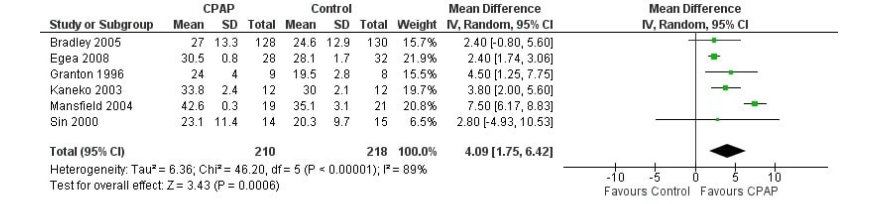
Results: A total of 3271 records were screened and investigated. Six randomized controlled trials with a total of 228 participants met the inclusion criteria. CPAP showed statistically significant improvements in LVEF (mean difference = 4.09, 95% confidence interval: 1.75 to 6.42; p = 0.0006) compared with a control group in patients with heart failure and sleep-disordered breathing. The adverse effects were not reported. All inculded articles were overall rated as having low risk of bias.
Conclusion
Conclusions: CPAP improves the LVEF in patients with heart failure and sleep-disordered breathing. Further multicenter studies with large sample sizes are needed