
Lots of interesting abstracts and cases were submitted for TCTAP 2026. Below are the accepted ones after a thorough review by our official reviewers. Don’t miss the opportunity to expand your knowledge!
ABS20251114_0002
Short Term Outcomes With the Use of a Dedicated Venous Stent With Intravascular Ultrasound Guided Liberation
By Carlos Abel Gutierrez Diaz
Presenter
Carlos Abel Gutierrez Diaz
Authors
Carlos Abel Gutierrez Diaz1
Affiliation
Hospital Angeles Pedregal, Mexico1
View Study Report
ABS20251114_0002
Venous Disease Intervention
Short Term Outcomes With the Use of a Dedicated Venous Stent With Intravascular Ultrasound Guided Liberation
Carlos Abel Gutierrez Diaz1
Hospital Angeles Pedregal, Mexico1
Background
Iliac vein stenting is the treatment of choice for patients with posthrombotic syndrome and iliac vein compression. The new dedicated venous stents provide higher diameters and larger lengths with precise deployment and stronger radial force, ideal characteristics for the treatment of these fibrotic and restrictive lesions. The intravascular ultrasound (IVUS) is a fundamental device to measure de proper stent diameter, length and to identify the proximal and distal landing zones. The use of intravascular ultrasound increases accuracy and is associated with improved outcomes and reduced complications. Furthermore, intravascular ultrasound (IVUS) helps in identifying significant lesions that are ambiguous by venography and reducing treatment of lesions that are proven insignificant. Additionally, several patients may have undiagnosed and/or underrecognized anatomic obstruction (May-Thurner syndrome). The venous stenting is indicated for symptomatic patients with lower extremity swelling and cutaneous changes.
Methods
Patients with obstructive disease of the common iliac, external iliac and femoral veins and a Clinical, Etiological, Anatomical, Pathophysiological class of 3 or higher or a Venous Clinical Severity Score of 2 or greater were enrolled in this retrospective, single center, single arm study in Mexico City. Patients with posthrombotic syndrome and iliac vein compression were included. Symptomatic venous reflux was measured with duplex ultrasound (greater than 1 second in the deep venous system) and lesion anatomy was assessed with CT scan. The patients were followed up for 12 months after the index procedure for the assessment of patency and safety.
Results
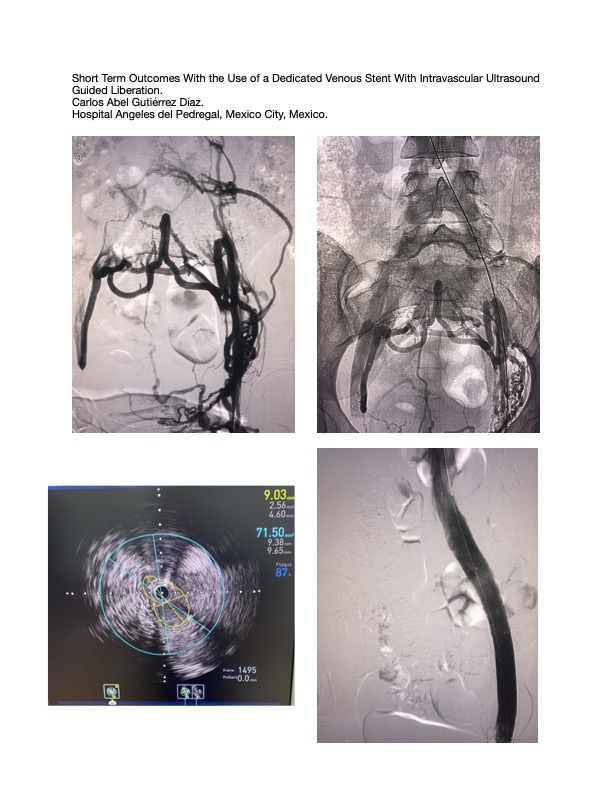
Between January 2022 and August 2025 a total of 50 patients were treated with a dedicated venous stent (Venovo, BD). The mean age was 59.2 years and 80% were women and 20% were men. Twenty patients with non thrombotic lesions and 30 patients with postrombotic lesions. The stent was measured with standard IVUS technique using 16mm Venovo stent for the common iliac vein, 14mm for the external iliac vein and 12mm for the common femoral vein. The overall 12-month primary patency rate was 88% (44/50), and the 12-month primary patency rate was 94.8% (19/20) for the nonthrombotic group and 80% (25/30) for the postthrombotic group. Following treatment all patients improve the CEAP and VCSS score.
Conclusion
The results of this study demonstrated good short term patency using a dedicated venous stent for iliofemoral obstruction. Iliac vein stenting with the Venovo (BD) venous stent is very effective with symptom improvement in the majority of patients. The endovascular approach is now a widely accepted standard. The utilization of intravascular ultrasound (IVUS) during venous stent placement was associated with better results and proper measures providing adequate stent inflow and outflow, factors the improve patency.