
Lots of interesting abstracts and cases were submitted for TCTAP 2026. Below are the accepted ones after a thorough review by our official reviewers. Don’t miss the opportunity to expand your knowledge!
ABS20251114_0001
Comparative Efficacy of Intravascular Lithotripsy and Rotational Atherectomy in Calcified Coronary Lesions: A Meta-Analysis of Randomized Controlled Trials
By Putu Ayu Widyastuti, Ketut Erna Bagiari
Presenter
Putu Ayu Widyastuti
Authors
Putu Ayu Widyastuti1, Ketut Erna Bagiari1
Affiliation
Sanjiwani General Hospital, Indonesia1
View Study Report
ABS20251114_0001
Adjunctive Procedures (Thrombectomy, Atherectomy, Special Balloons)
Comparative Efficacy of Intravascular Lithotripsy and Rotational Atherectomy in Calcified Coronary Lesions: A Meta-Analysis of Randomized Controlled Trials
Putu Ayu Widyastuti1, Ketut Erna Bagiari1
Sanjiwani General Hospital, Indonesia1
Background
Severely calcified coronary lesions pose a significant challenge in percutaneous coronary intervention (PCI), often compromising both its safety and efficacy. Several plaque modification techniques have been developed to optimize lesion preparation. Rotational atherectomy (RA) has long been established as a conventional approach to modify calcified plaques prior to stent implantation. More recently, intravascular lithotripsy (IVL) has emerged as a novel technology designed to fracture calcium within the vessel wall through acoustic pressure waves. However, evidence directly comparing IVL and RA remains limited, with only a few randomized controlled trials (RCTs) available. This study aims to compare the clinical and procedural outcomes of IVL versus RA in managing calcified coronary artery lesions.
Methods
A systematic search was conducted in PubMed, Embase, and the Cochrane Library for RCTs comparing IVL with RA in patients with calcified coronary lesions undergoing PCI. The primary endpoint was procedural success, while secondary outcomes included major adverse cardiovascular events (MACE), defined as cardiovascular death, myocardial infarction, target lesion revascularization, and stroke, as well as procedural complications and outcomes. The RoB 2 tool was used to assess the risk of bias for included studies. Statistical analyses were performed using Stata/SE 16.1, with pooled estimates calculated using random-effects models.
Results
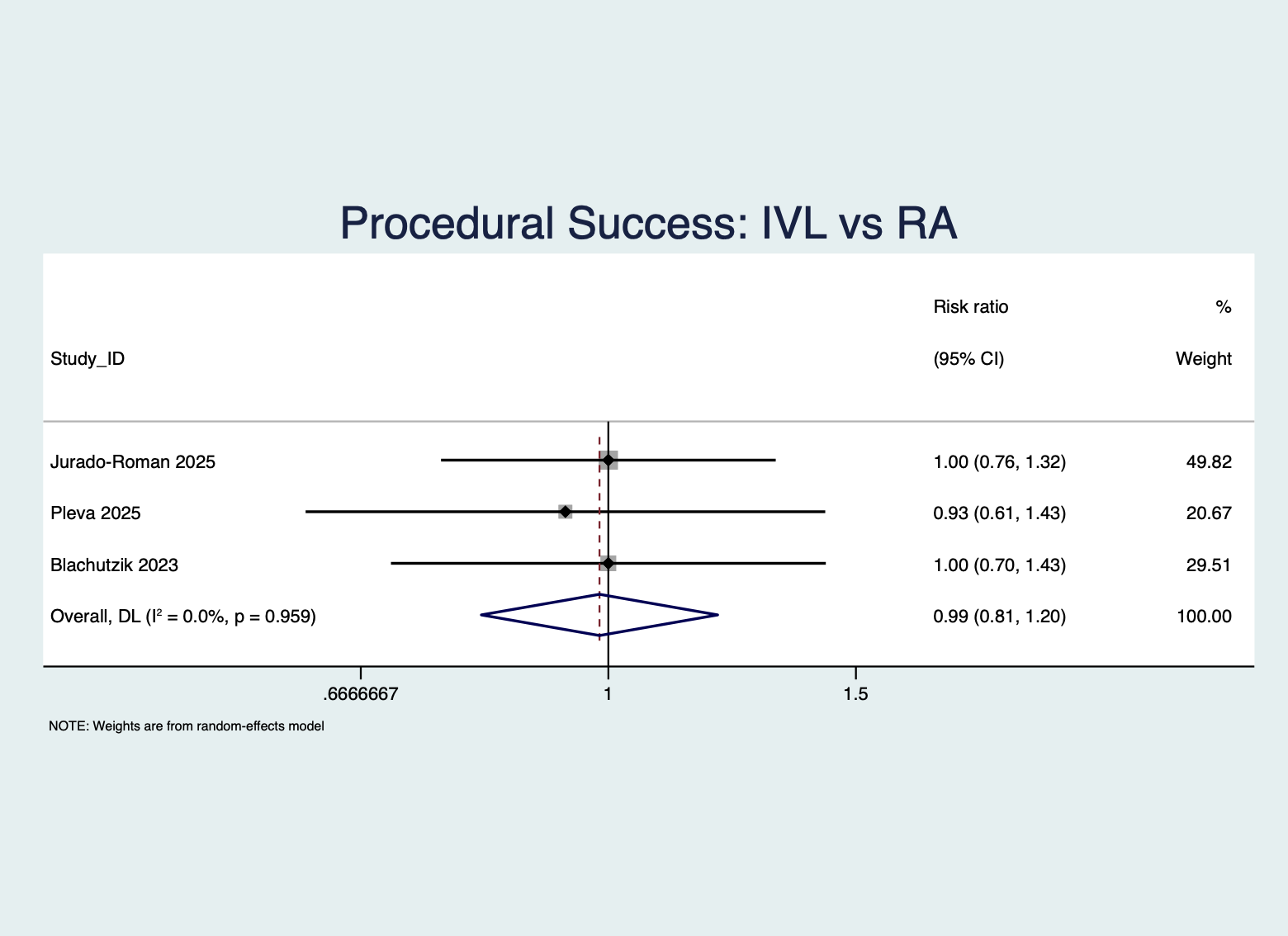
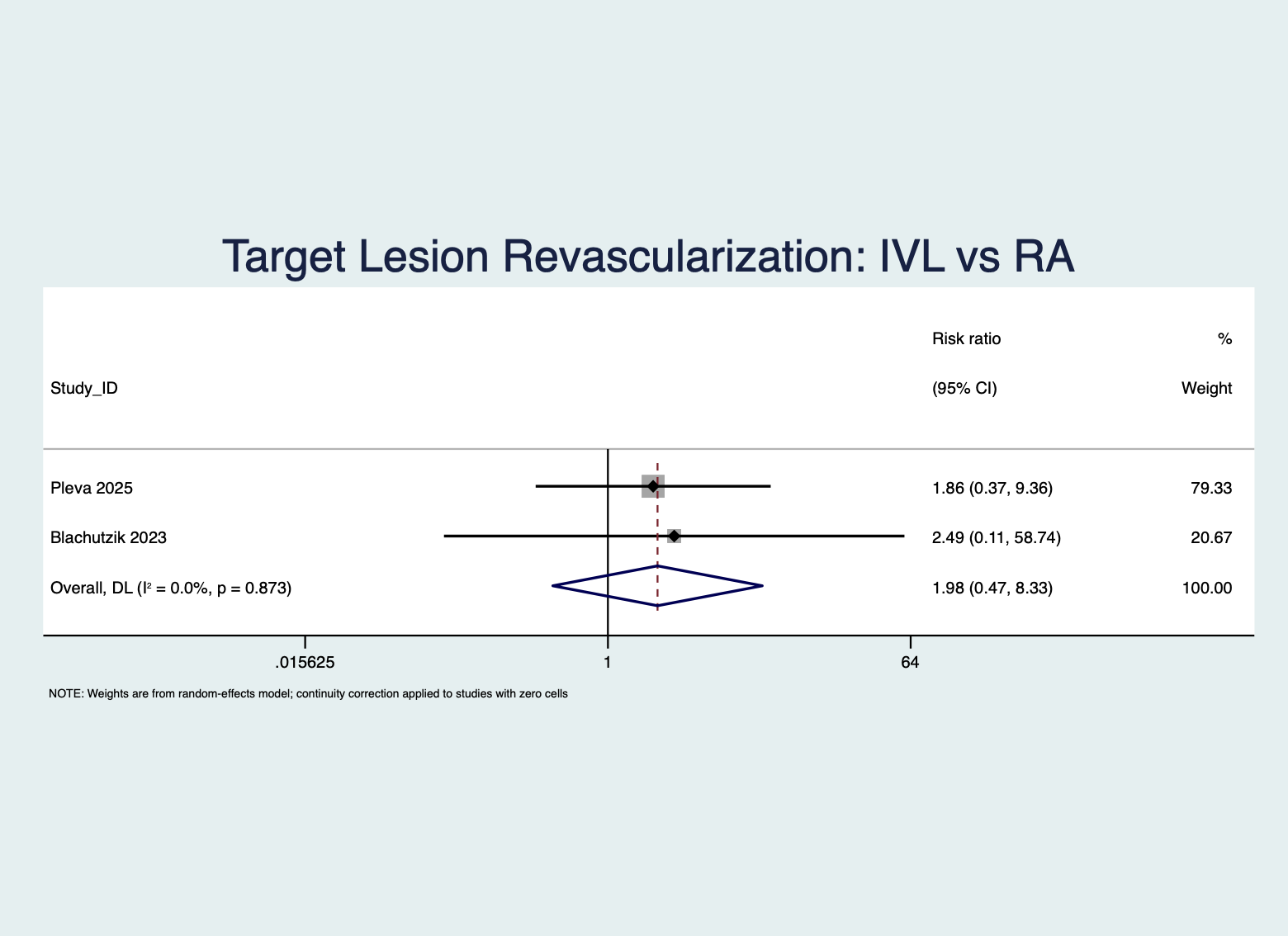
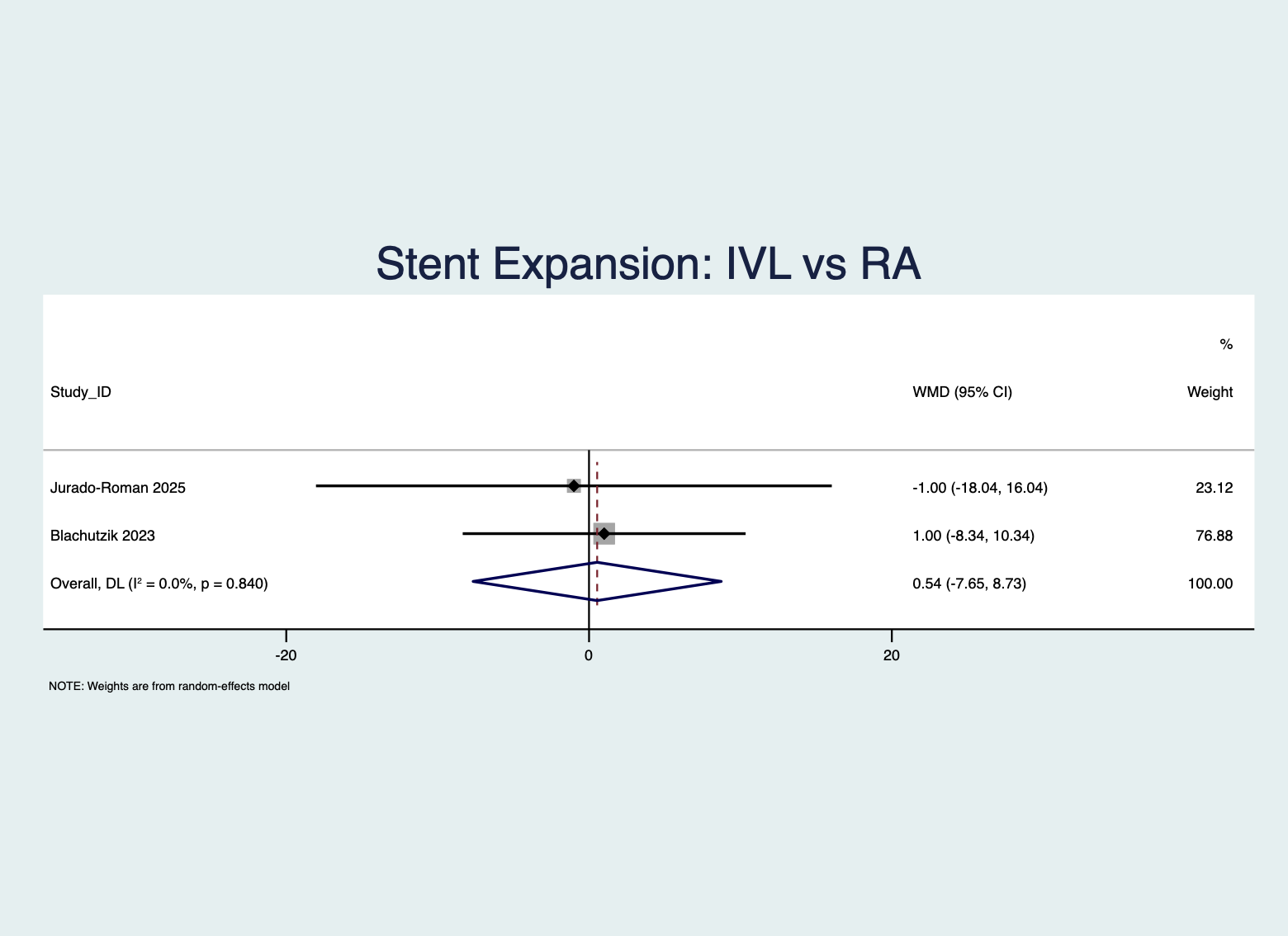
Three RCTs comprising a total of 225 patients were included. Meta-analysis of procedural success demonstrated no significant difference between IVL and RA (RR 0.99, 95 % CI 0.81 – 1.20; p = 0.88; I² = 0 %). Two studies involving 111 participants reported target lesion revascularization (TLR), with no statistically significant difference between IVL and RA (RR 1.98, 95 % CI 0.47 – 8.33; p = 0.35; I² = 0 %). A random-effects meta-analysis of two studies (n = 175) assessing stent expansion also revealed no significant difference between IVL and RA (WMD 0.54 %, 95 % CI −7.66 to 8.73; p = 0.90; I² = 0 %).
Conclusion
Intravascular lithotripsy (IVL) and rotational atherectomy (RA) demonstrated comparable outcomes in the management of calcified coronary artery lesions. Both techniques achieved similar rates of procedural success, target lesion revascularization, and stent expansion, with no evidence of heterogeneity across studies. Given the limited number of available RCTs, larger studies are warranted to further define the optimal lesion preparation strategies in PCI.