
Lots of interesting abstracts and cases were submitted for TCTAP 2026. Below are the accepted ones after a thorough review by our official reviewers. Don’t miss the opportunity to expand your knowledge!
ABS20251107_0009
Impact of Drug Coating Particle Size (Macro- vs. Nanoparticles) on TIMI Flow After Drug-Coated Balloon Angioplasty in STEMI: A Retrospective Analysis
By Min Su Kim, Mohsin Gondal, Sandeep Basavarajaiah
Presenter
Min Su Kim
Authors
Min Su Kim1, Mohsin Gondal1, Sandeep Basavarajaiah1
Affiliation
Heartlands Hospital, Birmingham, United Kingdom1
View Study Report
ABS20251107_0009
DES/BRS/DCB
Impact of Drug Coating Particle Size (Macro- vs. Nanoparticles) on TIMI Flow After Drug-Coated Balloon Angioplasty in STEMI: A Retrospective Analysis
Min Su Kim1, Mohsin Gondal1, Sandeep Basavarajaiah1
Heartlands Hospital, Birmingham, United Kingdom1
Background
Drug-coated balloons (DCBs) are increasingly utilised in the management of de novo coronary lesions, offering a stent-free alternative with potential advantages in ST-elevation myocardial infarction (STEMI), where microvascular integrity is often compromised. Therefore, there is a potential risk of particulate embolisation from DCB (Sirolimus or Paclitaxel) coatings, which may influence the reperfusion outcomes. Paclitaxel-coated balloons (PCBs) typically employ macro-particulate drug coatings visible to the naked eye, whereas sirolimus-coated balloons (SCBs) utilise nanoparticle formulations. The impact of these differing particle sizes on microcirculatory perfusion and angiographic outcomes in STEMI remains unexplored. This study evaluates post-procedural TIMI flow in patients undergoing DCB-only angioplasty with either PCB or SCB.
Methods
This is a single-centre, retrospective observational study conducted at Heartlands Hospital, UK. 212 STEMI cases treated with a DCB-only approach, between 2018 and 2022, were analysed. Patients received either PCB (n= 50) or SCB (n= 162). Study endpoints were comparison of the post-DCB TIMI flow (0-3), DCB diameter and length, and frequency of bailout stenting (due to recoil > 30% or flow-limiting dissection) for both DCB devices. A chi-square test was applied to assess statistical differences in TIMI 3 flow rates between the two devices.
Results
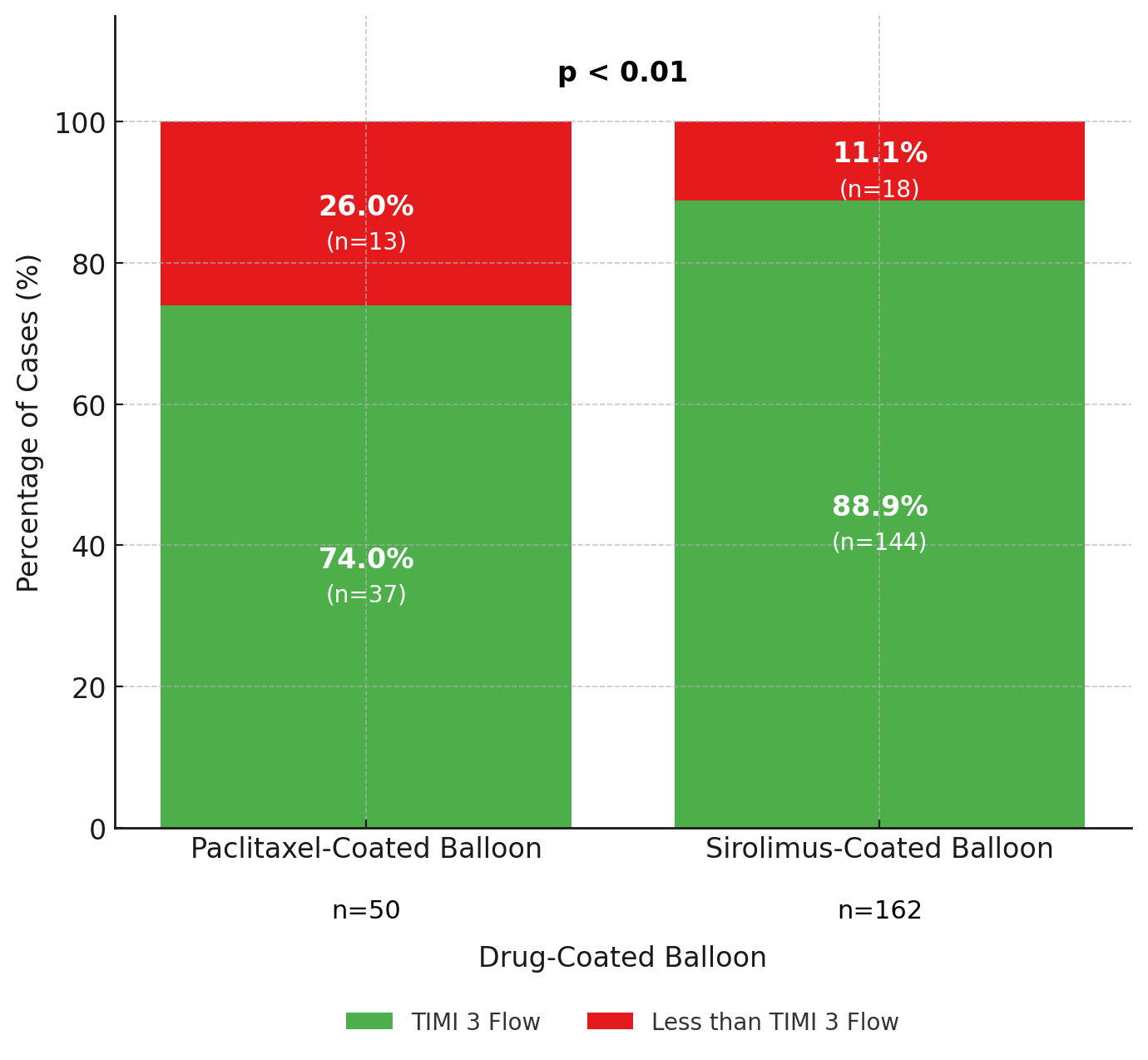
Final TIMI 3 flow was achieved in 74% of PCB and 88.9% of SCB cases (p < 0.01). Bailout stenting was infrequent (10% vs 8% respectively). Mean DCB diameter and length were comparable between the two cohorts (Diameter: 2.745 mm vs 2.801 mm; Length: 28 mm vs 27.5 mm, respectively). No significant differences were observed in lesion preparation techniques, including the use of non-compliant/semi-compliant balloons, cutting balloons, or intravascular imaging (IVUS/OCT).
Conclusion
This study suggests that drug-coating particle size may influence microvascular reperfusion in STEMI patients undergoing DCB-only angioplasty. The lower TIMI 3 flow observed in the PCB group may reflect macro-particulate embolisation and impaired microcirculatory recovery, whereas nanoparticle-based SCBs appear to preserve the perfusion more effectively. These findings support further investigation into the role of drug formulation in DCB performance and underscore the need for prospective, device-specific trials to optimise DCB use in primary PCI.