ABS20251106_0022
Computed Tomography
Quantitative Characterization of Circumferential Coronary Calcification Heterogeneity by Coronary CT Angiography
Atomu Tajima1, Taito Arai2, Koshiro Sakai3, kazumasa Ikeda2, Frederic Bouisset4, Diego Gallo5, Maurizio Lodi Rizzini5, Claudio Chiastra5, Takuya Mizukami6, James Spratt7, Tetsuya Amano8, Umberto Morbiducci5, Carlos Collet9
Aichi Medical University Hospital, Japan1, CoreAalst, Belgium2, Department of Cardiology, Showa University, Japan3, Toulouse University Hospital, France4, Department of Mechanical and Aerospace Engineering Politecnico di Torino, Italy5, Department of Clinical Pharmacology, Showa University, Japan6, Cardiology, St Georges University Hospitals NHS Foundation Trust, London, United Kingdom, United Kingdom7, Aichi Medical University Hospital, Jordan8, Cardiovascular Research Foundation, USA9
Background
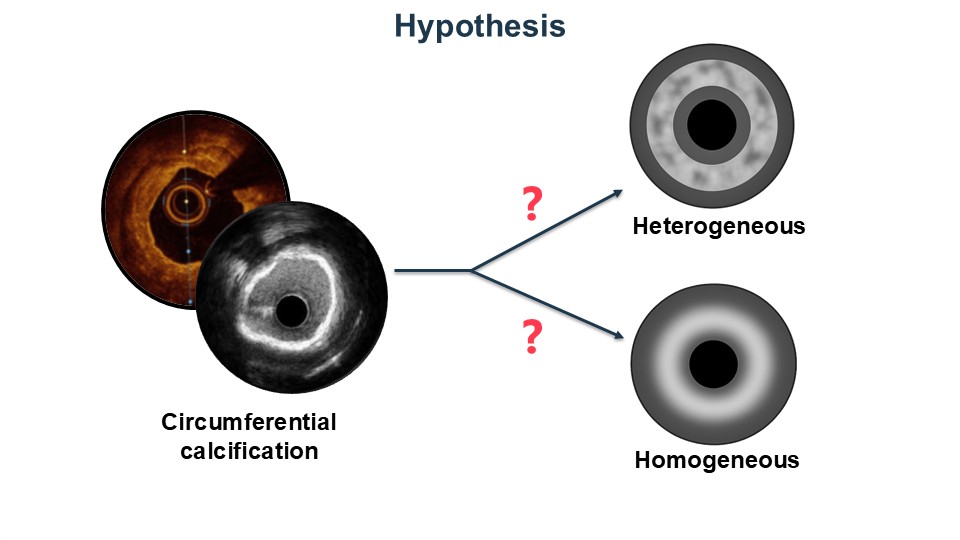
Circumferential coronary calcification (CCC) is associated with impaired stent expansion and suboptimal procedural outcomes in percutaneous coronary intervention (PCI). While intravascular imaging modalities such as intravascular ultrasound (IVUS)and optical coherence tomography (OCT) can identify calcium, they are limited in assessing its internal heterogeneity. Coronary computed tomography angiography (CCTA), via voxel-level analysis of Hounsfield Units (HU), allows for detailed evaluation of calcium density and distribution. This study aimed to quantify the heterogeneity of HU distribution within CCC using the coefficient of variation (CV) and Shannon entropy.
Methods
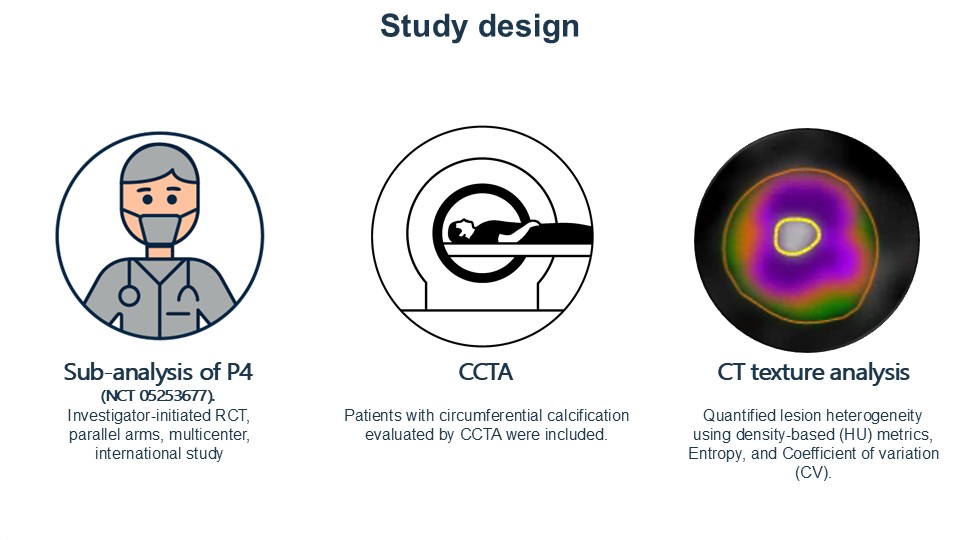
From a registry of 1,075 patients who underwent CCTA prior to CT- and IVUS-guided PCI between April 2022 and July 2025, coronary segments with 360° circumferential calcification were identified. CCC was defined as a continuous arc of calcium spanning the entire vessel circumference in at least one axial cross-section. When multiple cross-sections were available, the frame with the highest HU was selected. CV was calculated as the ratio of the standard deviation to the mean HU. Shannon entropy was used to assess the complexity and uniformity of the HU distribution.
Results
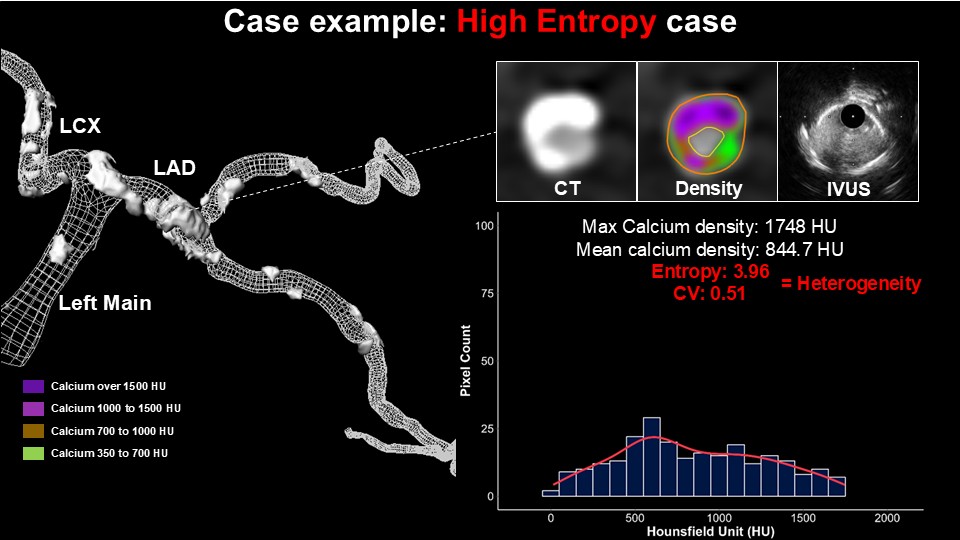
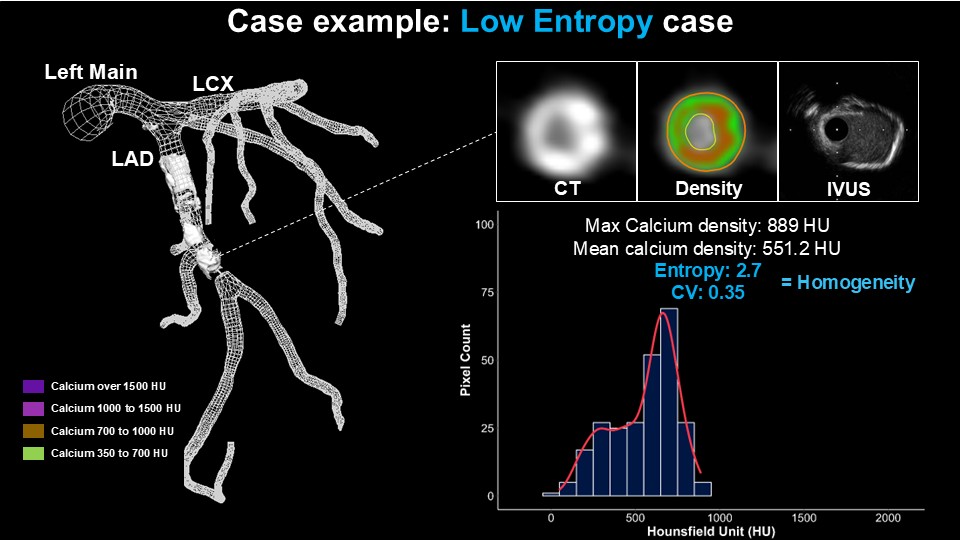
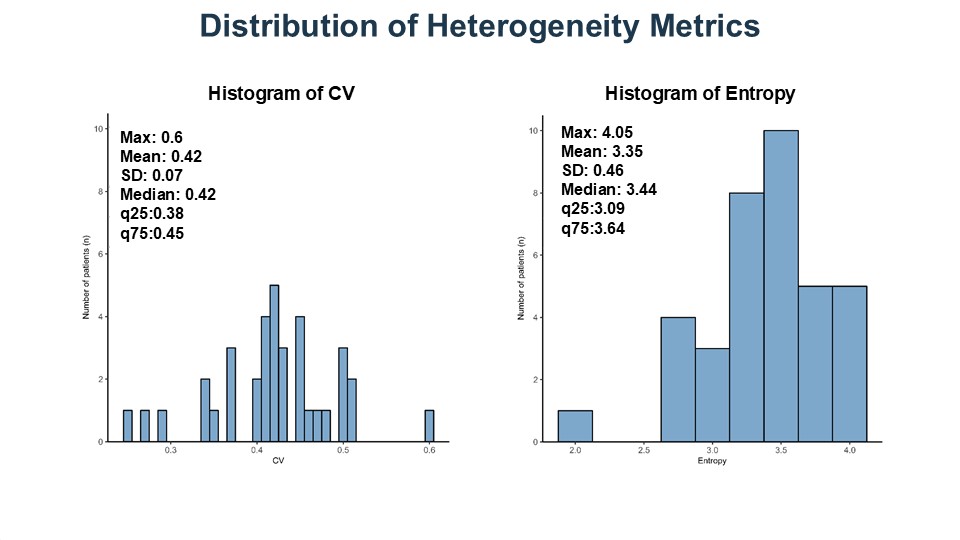
A total of 25 vessels from 23 patients with CCC were analyzed (mean age, 71 ± 6.4 years; 21 male). The maximum HU within calcified segments was 2,062, with a mean of 1,454 ± 332 and a median of 1,490 (IQR, 1,153–1,629). The density distribution within CCC demonstrated marked heterogeneity, with a CV of 0.40 ± 0.06. Shannon entropy values were 3.37 ± 0.50, reflecting non-uniformity in the spatial distribution of calcium density across the vessel circumference.
Conclusion
Circumferential coronary calcification is predominantly composed of high-density calcium yet exhibits significant internal heterogeneity. The coefficient of variation highlights substantial variability in calcium density within the calcified arc, while the observed entropy indicates a moderate-to-high non-uniformity in spatial distribution. These findings suggest that even morphologically concentric calcifications may harbor heterogeneous internal architecture, potentially influencing mechanical compliance and responsiveness to balloon dilatation.