E-Abstract

Lots of interesting abstracts and cases were submitted for TCTAP 2026. Below are the accepted ones after a thorough review by our official reviewers. Don¡¯t miss the opportunity to expand your knowledge!

ABS20251106_0010

Intervention for Chronic Total Occlusion Involving Bifurcation Lesions: Insights From the TRIO CTO (Taiwan Research Initiative on Coronary Total Occlusion) Registry

By Ying-Chang Tung

Presenter

Ying-Chang Tung

Authors

Ying-Chang Tung1

Affiliation

Linkou Chang Gung Memorial Hospital, Taiwan1
View Study Report
ABS20251106_0010
CTO

Intervention for Chronic Total Occlusion Involving Bifurcation Lesions: Insights From the TRIO CTO (Taiwan Research Initiative on Coronary Total Occlusion) Registry

Ying-Chang Tung1

Linkou Chang Gung Memorial Hospital, Taiwan1

Background

Percutaneous coronary intervention (PCI) for chronic total occlusion (CTO) remains technically challenging, with lower success and higher complication rates than non-CTO PCI. Among lesion-specific factors, bifurcation involvement within or near the occluded segment adds substantial procedural complexity. Approximately one-third of CTOs contain a relevant side branch (SB), increasing the risk of dissection, SB occlusion, or subintimal shift.Despite this, current angiographic CTO scores (e.g., J-CTO, PROGRESS-CTO) do not account for bifurcation anatomy. The recent EuroCTO–EBC expert consensus emphasizes bifurcation location (proximal, distal, or intralesional) as a determinant of procedural planning and strategy—advocating early SB wiring, intravascular imaging guidance, and avoidance of aggressive dissection–reentry to minimize complications.However, real-world data on the impact of bifurcation CTO on procedural success, mechanisms of SB compromise, and clinical outcomes remain limited. The TRIO-CTO (Taiwan Research Initiative on Coronary Total Occlusion) registry aims to systematically evaluate the prevalence, angiographic patterns, and procedural outcomes of bifurcation CTO, and to determine whether incorporating bifurcation morphology into existing CTO scoring systems improves the prediction of technical failure and adverse events.

Methods

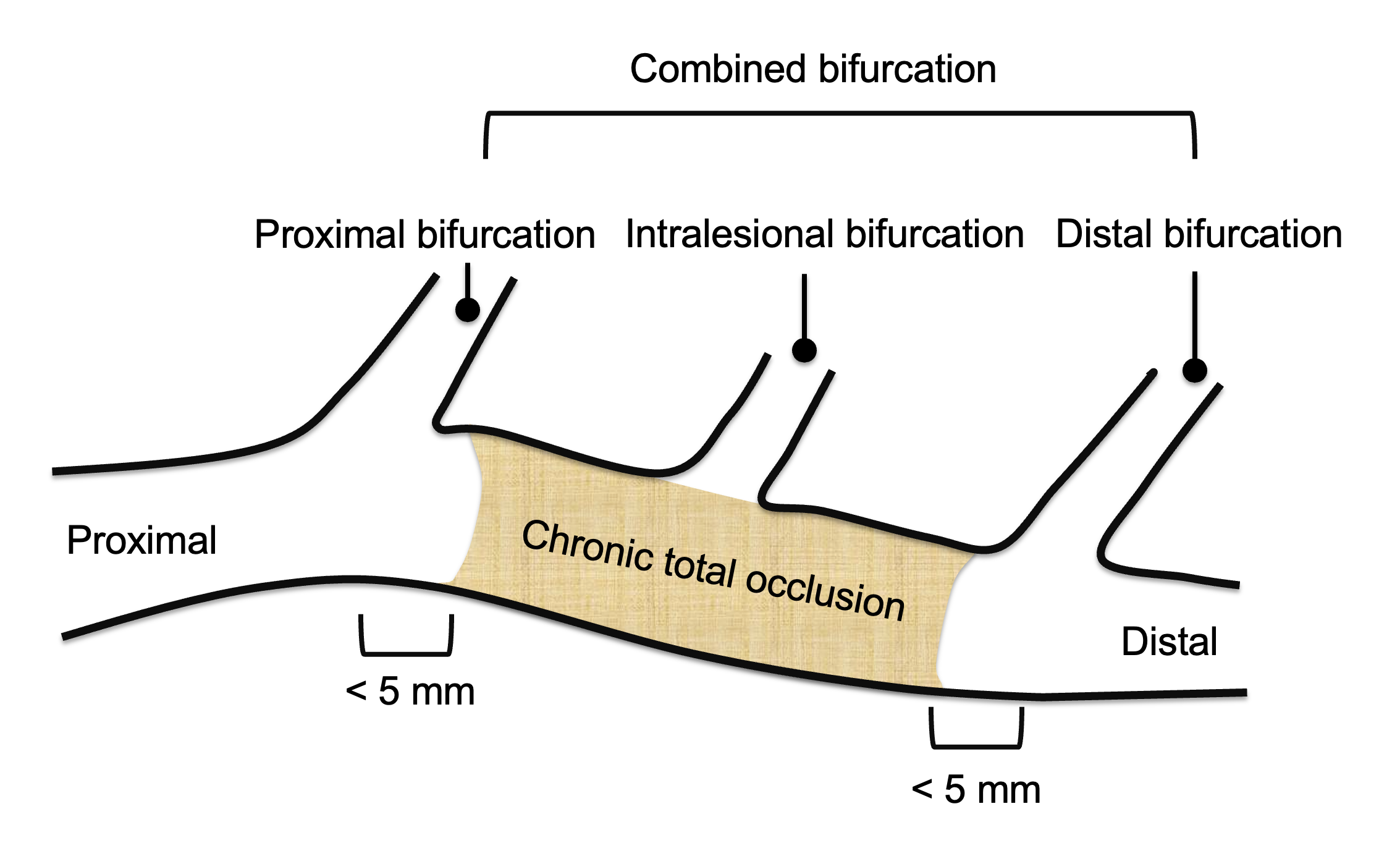
We retrospectively analyzed CTO PCI procedures performed between January 2017 and April 2022 in the TRIO-CTO registry, a collaborative study among three tertiary centers in northern Taiwan: National Taiwan University Hospital, Taipei Veterans General Hospital, and Linkou Chang Gung Memorial Hospital.Bifurcation CTO was defined as a coronary occlusion without antegrade flow for more than three months involving a relevant side branch (SB) ¡Ã2 mm in diameter. Lesions were categorized according to SB location as proximal (within 5 mm of the proximal cap), distal (within 5 mm of the distal cap), intralesional (within the CTO body), or combined (relevant SBs within 5 mm of both the proximal and distal caps).Technical success was defined as residual stenosis <30% with TIMI 3 flow and no SB occlusion or compromise (defined as SB TIMI flow grade <3). Procedural success was defined as technical success without in-hospital major adverse cardiovascular events (MACE), including death, myocardial infarction, stroke, emergency bypass surgery, cardiac tamponade requiring drainage, or access-site complications requiring intervention or blood transfusion.The impact of bifurcation CTO and complex bifurcation CTO (intralesional or combined type) on technical success was evaluated using multivariable logistic regression and receiver operating characteristic (ROC) analysis.

Results

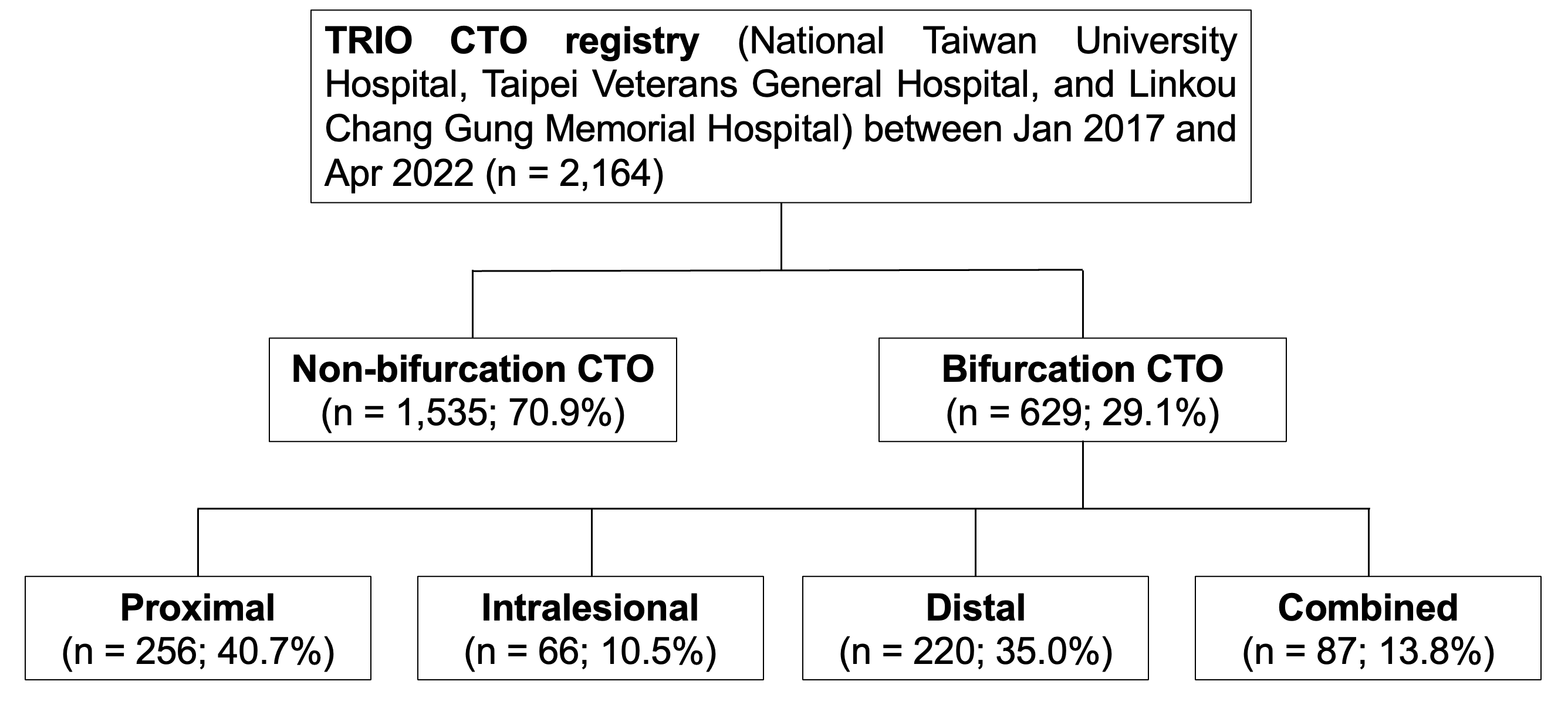
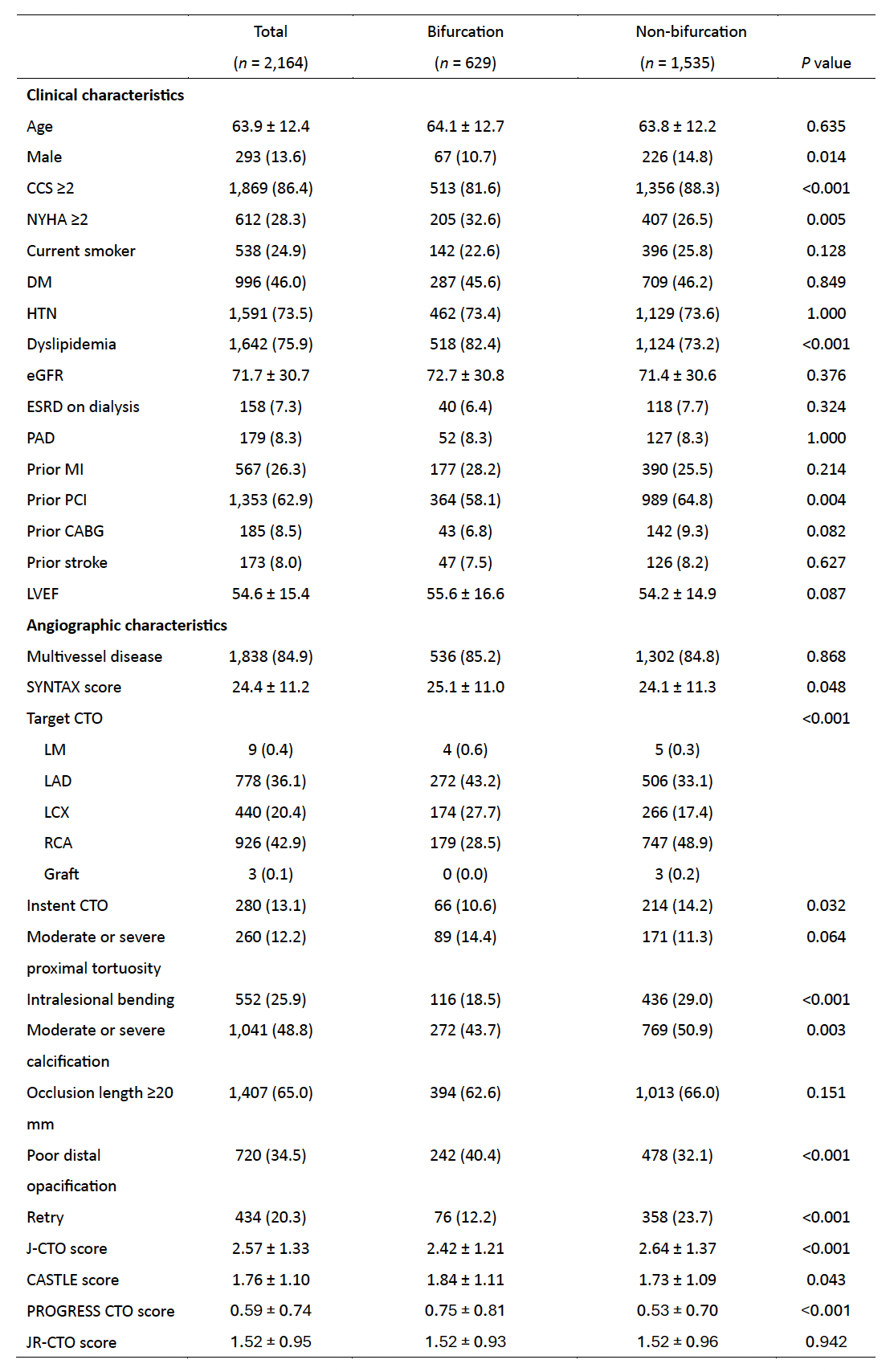
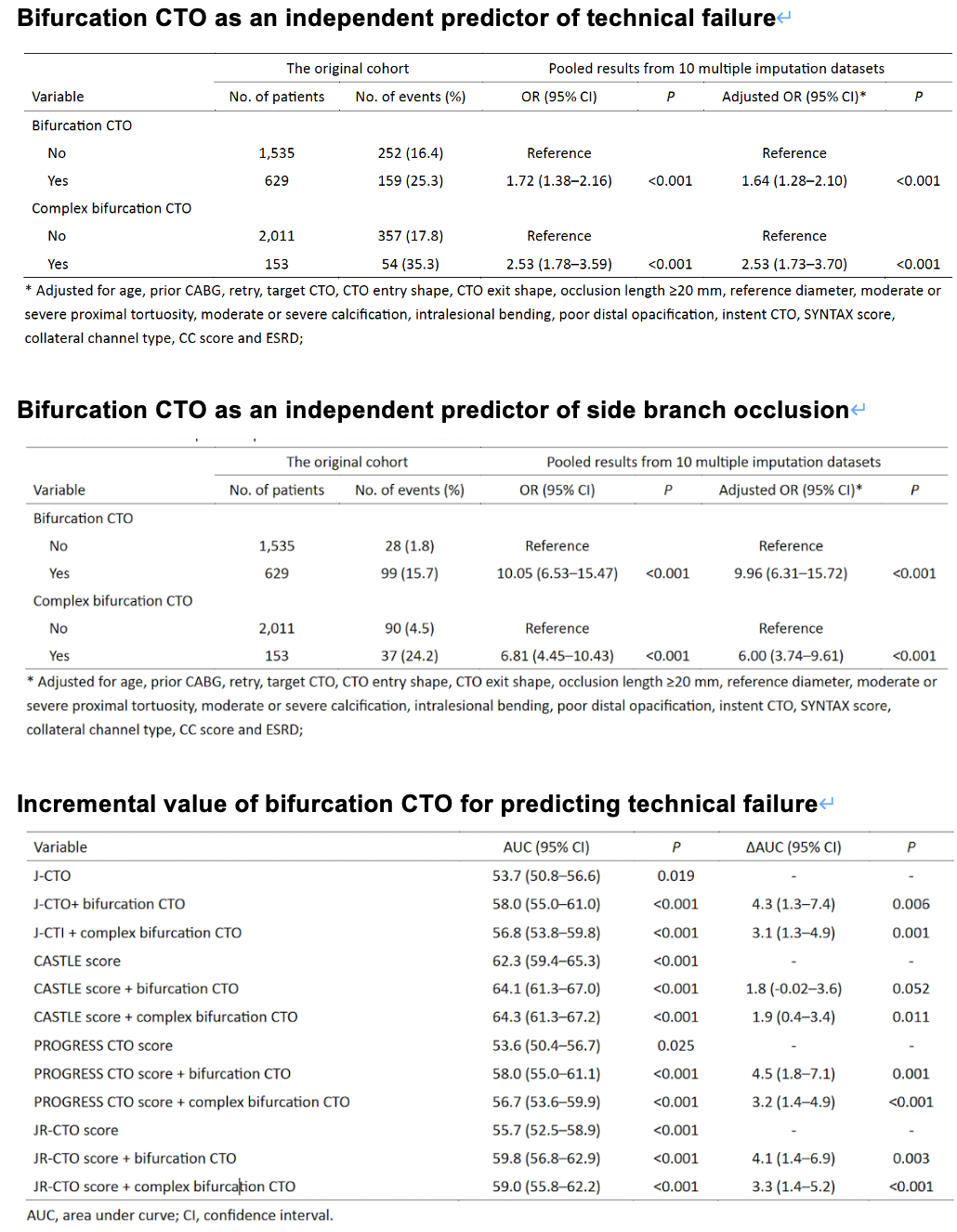
A total of 2,164 CTO PCI procedures were analyzed between January 2017 and April 2022, of which 29.1% were classified as bifurcation CTO. Among these, 40.7% involved the proximal cap, 35.0% the distal cap, 10.5% were intralesional, and 13.0% were combined bifurcations.Compared with non-bifurcation CTO, bifurcation CTO had a lower J-CTO score (2.42 ¡¾ 1.21 vs. 2.64 ¡¾ 1.37, p < 0.001), but higher CASTLE (1.84 ¡¾ 1.11 vs. 1.73 ¡¾ 1.09, p = 0.043) and PROGRESS-CTO scores (0.75 ¡¾ 0.81 vs. 0.53 ¡¾ 0.70, p < 0.001), while the JR-CTO score was similar (1.52 ¡¾ 0.93 vs. 1.52 ¡¾ 0.96, p = 0.942).The technical success rate was significantly lower in bifurcation than in non-bifurcation CTO (74.7% vs. 83.6%; p = 0.004), mainly due to a higher incidence of side-branch (SB) occlusion (15.7% vs. 1.8%; p = 0.005). Intralesional and combined bifurcation CTOs showed lower technical success and higher SB occlusion rates compared with proximal or distal bifurcations.In multivariable logistic regression, both bifurcation CTO and complex bifurcation CTO (intralesional or combined) were independent predictors of technical failure. Adding bifurcation or complex bifurcation CTO to conventional scoring systems significantly improved the discriminative performance, as reflected by an increase in AUC on ROC analysis for predicting technical failure.


Conclusion

Bifurcation involvement is common in CTO PCI and independently predicts technical failure, primarily due to a higher risk of side-branch occlusion. Complex bifurcation CTOs, particularly intralesional and combined types, are associated with the lowest procedural success. Incorporating bifurcation characteristics into existing CTO scoring systems significantly improves the prediction of technical outcomes and may enhance procedural planning and risk stratification.