E-Abstract

Lots of interesting abstracts and cases were submitted for TCTAP 2026. Below are the accepted ones after a thorough review by our official reviewers. Don¡¯t miss the opportunity to expand your knowledge!

ABS20251105_0008

Clinical Outcomes of Patients With Coronary Artery Disease Treated With Paclitaxel vs. Sirolimus Drug-Coated Balloons

By Nancy Virginia, Kai Soon Liew, Huan Yean Kang, Chai Yih Tan, Vijayendran Rajalingam, Aditya Fahmi Prianda, Prabahkar Subramaniam, Kenneth Kay Leong Khoo, Mohd Khairi Othman, Christian Sunur, Pirevina Naidu, MN Azalizam Abdullah, Nurul Syifaa Najwa Nadzri, Muhammad Anis bin Abdul Aziz, Saravanan Krishinan, Kantha Rao Narasamuloo, Chee Tat Liew, Wirash Kehasukcharoen, Anek Kanoksilp, Manan Pareek, Dharmaraj Karthikesan

Presenter

Nancy Virginia

Authors

Nancy Virginia1, Kai Soon Liew1, Huan Yean Kang1, Chai Yih Tan1, Vijayendran Rajalingam1, Aditya Fahmi Prianda1, Prabahkar Subramaniam1, Kenneth Kay Leong Khoo1, Mohd Khairi Othman1, Christian Sunur1, Pirevina Naidu1, MN Azalizam Abdullah1, Nurul Syifaa Najwa Nadzri1, Muhammad Anis bin Abdul Aziz2, Saravanan Krishinan1, Kantha Rao Narasamuloo1, Chee Tat Liew3, Wirash Kehasukcharoen4, Anek Kanoksilp4, Manan Pareek5, Dharmaraj Karthikesan1

Affiliation

Hospital Sultanah Bahiyah, Malaysia1, Hos, Malaysia2, Hospital Pantai, Malaysia3, Central Chest Institute of Thailand, Thailand4, Copenhagen University Hospital - Herlev and Gentofte, Copenhagen , Denmark5
View Study Report
ABS20251105_0008
DES/BRS/DCB

Clinical Outcomes of Patients With Coronary Artery Disease Treated With Paclitaxel vs. Sirolimus Drug-Coated Balloons

Nancy Virginia1, Kai Soon Liew1, Huan Yean Kang1, Chai Yih Tan1, Vijayendran Rajalingam1, Aditya Fahmi Prianda1, Prabahkar Subramaniam1, Kenneth Kay Leong Khoo1, Mohd Khairi Othman1, Christian Sunur1, Pirevina Naidu1, MN Azalizam Abdullah1, Nurul Syifaa Najwa Nadzri1, Muhammad Anis bin Abdul Aziz2, Saravanan Krishinan1, Kantha Rao Narasamuloo1, Chee Tat Liew3, Wirash Kehasukcharoen4, Anek Kanoksilp4, Manan Pareek5, Dharmaraj Karthikesan1

Hospital Sultanah Bahiyah, Malaysia1, Hos, Malaysia2, Hospital Pantai, Malaysia3, Central Chest Institute of Thailand, Thailand4, Copenhagen University Hospital - Herlev and Gentofte, Copenhagen , Denmark5

Background

Drug-coated balloons (DCBs) have emerged as an important strategy in percutaneous coronary intervention (PCI), offering the advantage of restoring vessel patency while avoiding permanent metallic implants. Paclitaxel DCBs have been widely used with well-established evidence, whereas sirolimus-based DCBs represent a newer technology with promising pharmacokinetic and antiproliferative profiles. However, direct comparative data—particularly from real-world, heterogeneous patient cohorts—remain scarce. This study aimed to evaluate and compare clinical outcomes between paclitaxel and sirolimus DCBs across a broad spectrum of coronary presentations.

Methods

This single-center retrospective registry included all consecutive patients undergoing DCB-only PCI between January 2023 and July 2024. Patients were enrolled irrespective of clinical presentation, encompassing chronic coronary syndrome (CCS) and acute coronary syndromes (STEMI, NSTEMI, and unstable angina). Treatment strategy, balloon preparation, and DCB selection were left to operator discretion. Lesions were treated exclusively with either paclitaxel or sirolimus DCBs. The primary endpoint was target lesion failure (TLF), defined as a composite of cardiac death, target vessel myocardial infarction, or clinically driven target lesion revascularization (TLR). Outcomes were assessed at 30 days and 1 year. Due to the relatively low event rates, data were analyzed descriptively.

Results

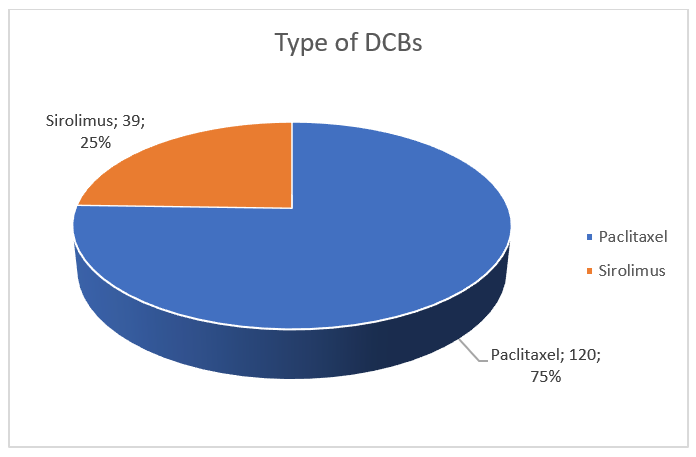
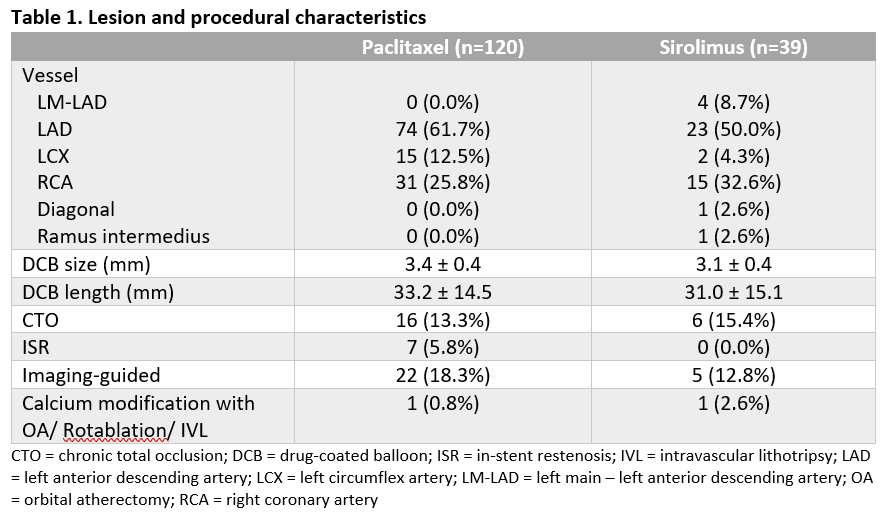
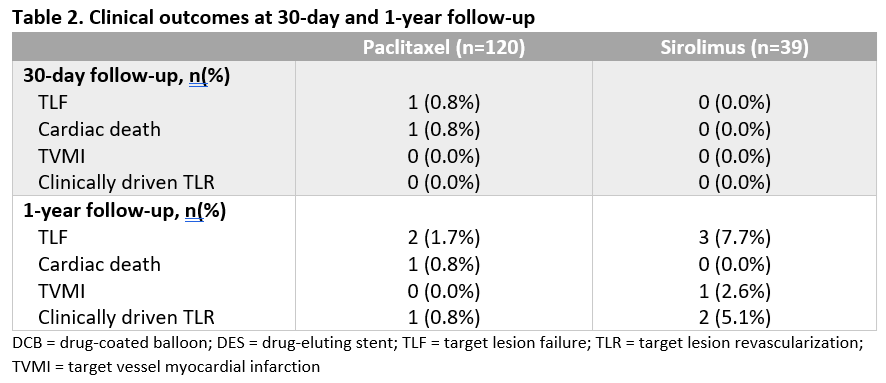
A total of 149 patients with 159 lesions were included, of whom 120 received paclitaxel DCBs and 39 received sirolimus DCBs. Most patients presented with CCS (58%), while 22% had STEMI, 13% NSTEMI, and 7% unstable angina. The left anterior descending artery was the most commonly treated vessel in both groups. At 30 days, TLF occurred in only 1 patient (0.8%) in the paclitaxel group, with no events observed in the sirolimus cohort. By 1 year, TLF was documented in 2 paclitaxel-treated patients (1.7%) and 3 sirolimus-treated patients (7.7%). Although numerically higher in the sirolimus group, these differences should be interpreted cautiously given the limited sample size and event numbers.


Conclusion

Both paclitaxel and sirolimus DCBs showed excellent short-term safety and performance in a broad real-world cohort, including ACS presentations. At 1 year, TLF was numerically lower with paclitaxel, but the small sample size limits definitive comparison. Larger prospective studies are needed to clarify relative long-term outcomes.