
Lots of interesting abstracts and cases were submitted for TCTAP 2026. Below are the accepted ones after a thorough review by our official reviewers. Don’t miss the opportunity to expand your knowledge!
ABS20251105_0004
SGLT2 Inhibition as an Adjunct Strategy to Improve Outcomes After Transcatheter Aortic Valve Implantation: A Systematic Review and Meta-Analysis
By Khadeeja Ali Hamzah, Yousif Hameed Kurmasha, Ali Saad Al-Shammari, Mohammedsadeq A. shweliya, Ali Alsajad Hussein Al-Janabi, Yasar Sattar
Presenter
Yousif Hameed Kurmasha
Authors
Khadeeja Ali Hamzah1, Yousif Hameed Kurmasha2, Ali Saad Al-Shammari3, Mohammedsadeq A. shweliya3, Ali Alsajad Hussein Al-Janabi1, Yasar Sattar4
Affiliation
ALkindy College of Medicine / University of Baghdad,Baghdad, Iraq1, College of Medicine, University of Kufa, Najaf, Iraq2, University of Baghdad College of Medicine,Baghdad, Iraq3, West Virginia University, Camden Clark Medical Center, Parkersburg, WV, USA4
View Study Report
ABS20251105_0004
Pharmacotherapy (Innovation)
SGLT2 Inhibition as an Adjunct Strategy to Improve Outcomes After Transcatheter Aortic Valve Implantation: A Systematic Review and Meta-Analysis
Khadeeja Ali Hamzah1, Yousif Hameed Kurmasha2, Ali Saad Al-Shammari3, Mohammedsadeq A. shweliya3, Ali Alsajad Hussein Al-Janabi1, Yasar Sattar4
ALkindy College of Medicine / University of Baghdad,Baghdad, Iraq1, College of Medicine, University of Kufa, Najaf, Iraq2, University of Baghdad College of Medicine,Baghdad, Iraq3, West Virginia University, Camden Clark Medical Center, Parkersburg, WV, USA4
Background
Patients undergoing transcatheter aortic valve implantation (TAVI) remain at elevated risk of mortality, heart failure hospitalization, and cardiorenal complications despite procedural advances. Sodium–glucose cotransporter-2 inhibitors (SGLT2i) have demonstrated cardioprotective and renoprotective effects across heart failure populations, but their role in the post-TAVI setting remains unclear. This study evaluated the impact of SGLT2 inhibitor therapy on clinical outcomes in patients with severe aortic stenosis undergoing TAVI.
Methods
A systematic search of PubMed, Embase, Cochrane Library, Scopus, and Web of Science was conducted through October 2025. Randomized and observational comparative studies evaluating SGLT2 inhibitors versus standard care after TAVI were included. Primary outcomes were all-cause mortality and heart failure hospitalization. Secondary outcomes included cardiac death, myocardial infarction, stroke, pacemaker implantation, and bleeding events. Pooled risk ratios (RR) and 95% confidence intervals (CI) were calculated using random-effects models, with heterogeneity assessed using I². Trial Sequential Analysis (TSA) was performed (α=5%, power=80%) to determine conclusiveness. Certainty of evidence was rated using the GRADE approach.
Results
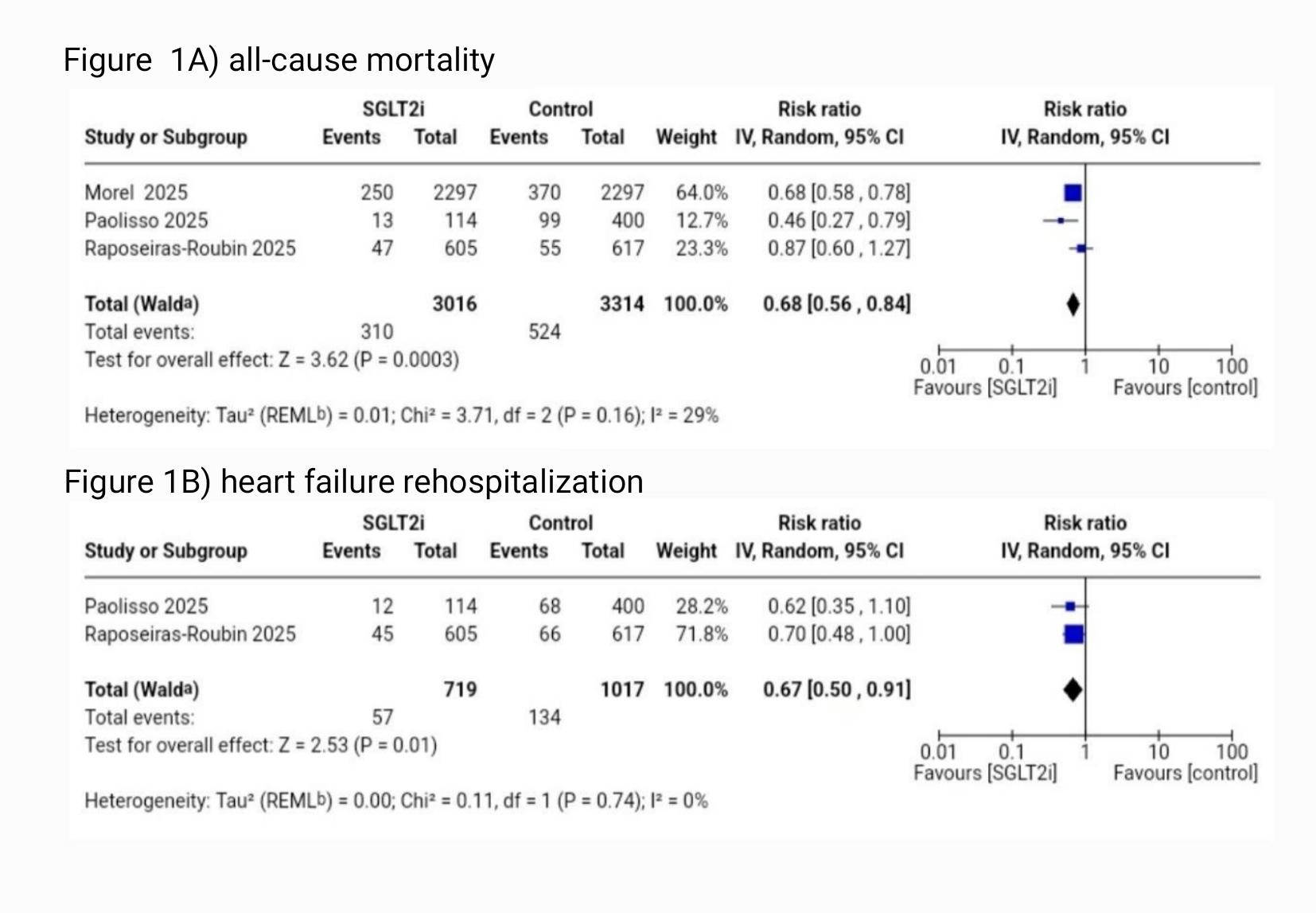
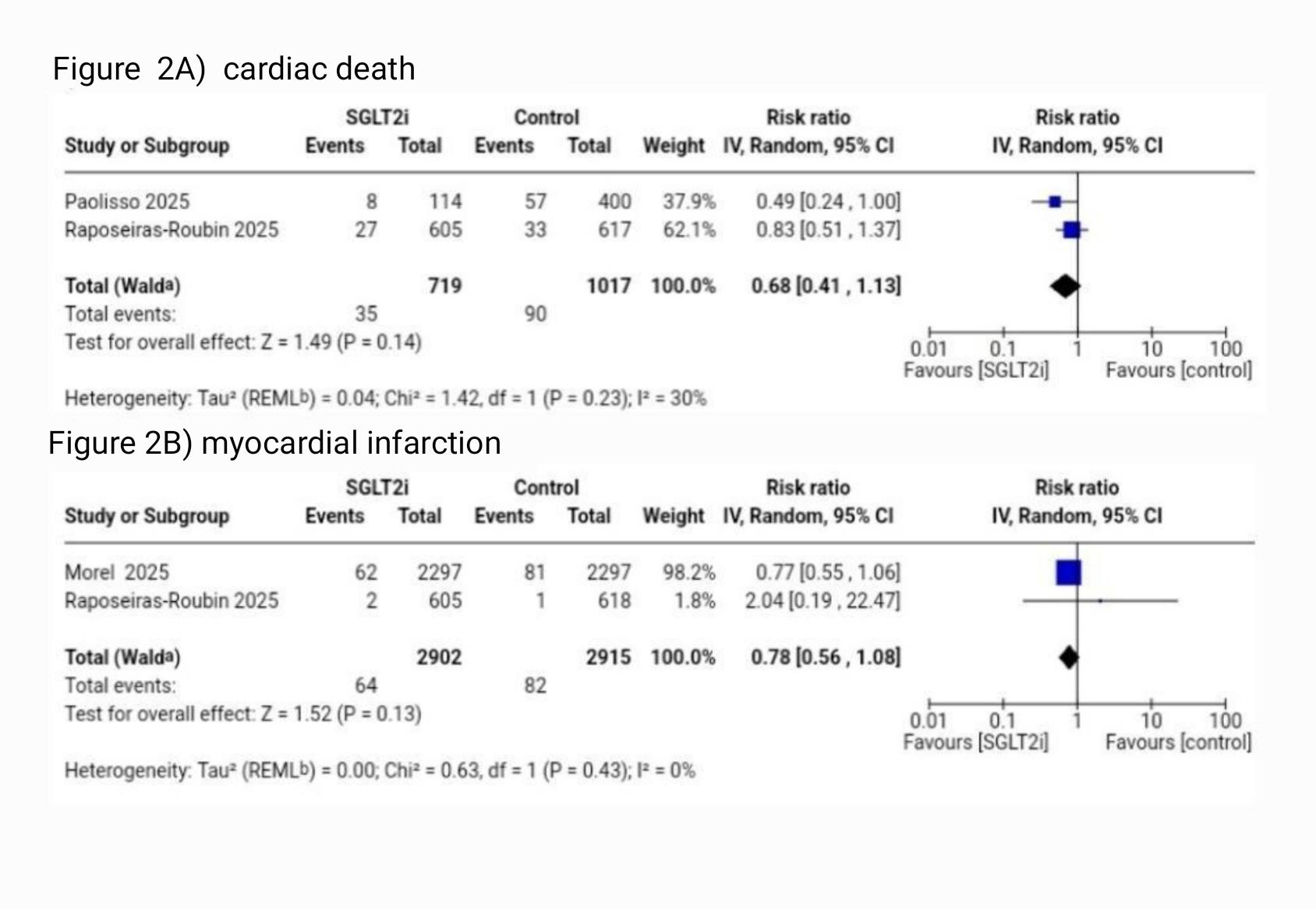
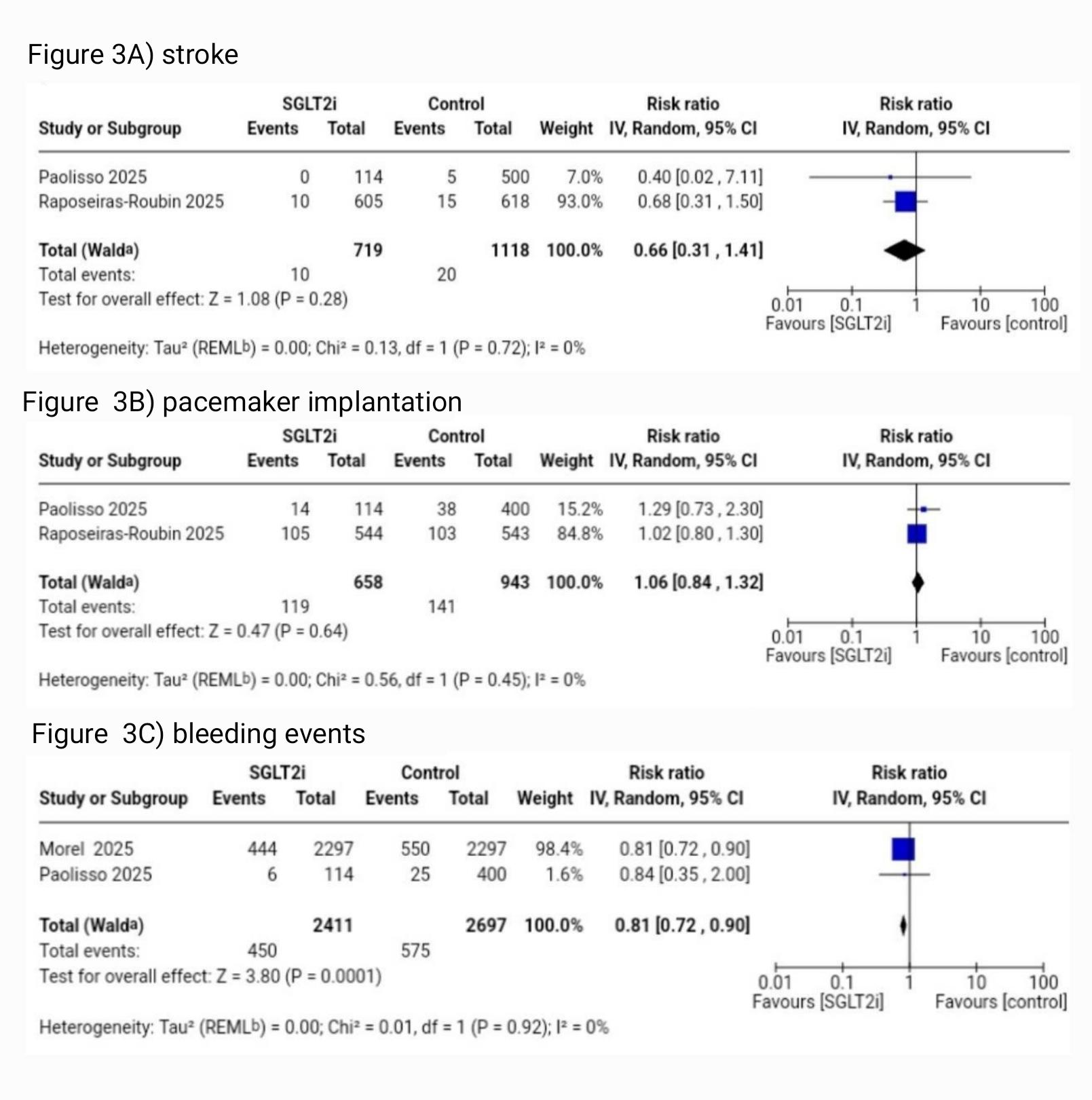
Results.Three studies (n = 6,330 patients)were included. SGLT2 inhibitor therapy reduced all-cause mortality (RR 0.68,95% CI 0.56–0.84; I² = 29%, Figure 1A) and reduced heart failurehospitalization (RR 0.67, 95% CI 0.50–0.91; I² = 0%, Figure 1B). TSA confirmedthat the accrued sample size exceeded the required information size for bothoutcomes. Bleeding events were also reduced (RR 0.81, 95% CI 0.72–0.90; I² =0%, Figure 3C). Cardiac death (RR 0.68, 95% CI 0.41–1.13; I²=30%, Figure 2A),myocardial infarction (RR 0.78, 95% CI 0.56–1.08; I²=0%, Figure 2B), stroke (RR0.66, 95% CI 0.31–1.41; I²=0%, Figure 3A), and pacemaker implantation (RR 1.06,95% CI 0.84–1.32; I²=0%, Figure 3B) were not significantly different. GRADEcertainty was high for all-cause mortality, heart failure hospitalization, andbleeding, and moderate for cardiac death, myocardial infarction, stroke, andpacemaker implantation.
TAVI.jpg
TAVI2.jpg
TAVI3.jpg
TAVI.jpg
TAVI2.jpg
TAVI3.jpg
Conclusion
SGLT2 inhibitor therapysignificantly reduces mortality, heart failure hospitalization, and bleedingrisk after TAVI, with TSA confirming the robustness of these findings andhigh-certainty evidence supporting their clinical relevance. These data supportSGLT2 inhibitors as an effective adjunct strategy after TAVI. Dedicatedrandomized trials are needed to define optimal timing and patient selection.