E-Abstract

Lots of interesting abstracts and cases were submitted for TCTAP 2026. Below are the accepted ones after a thorough review by our official reviewers. Don¡¯t miss the opportunity to expand your knowledge!

ABS20251102_0001

Comparative Outcomes of Transcatheter, Sutureless, and Surgical Aortic Valve Replacement in Patients With Low-to-Intermediate Surgical Risk: A Systematic Review and Network Meta-Analysis

By Bernadus Bernardino Bramantyo, Irene Yasmina Vilado, Naomi Natasha Napitupulu, Paulina Lusty Artanti, Bernardinus Prima Ardjie Pradipta, Khansa Maria, Pirel Aulia Baravia, Gerardo Kridanto Agung Laksono, Karina Yesika Manalu, Vanessa Carolina Gunawan, Koernia Kusuma Wardhana, Dyah Wulan Anggrahini, Lucia Kris Dinarti

Presenter

Bernadus Bernardino Bramantyo

Authors

Bernadus Bernardino Bramantyo1, Irene Yasmina Vilado2, Naomi Natasha Napitupulu1, Paulina Lusty Artanti3, Bernardinus Prima Ardjie Pradipta4, Khansa Maria1, Pirel Aulia Baravia5, Gerardo Kridanto Agung Laksono6, Karina Yesika Manalu7, Vanessa Carolina Gunawan8, Koernia Kusuma Wardhana9, Dyah Wulan Anggrahini1, Lucia Kris Dinarti1

Affiliation

Department of Cardiology and Vascular Medicine, Dr. Sardjito General Hospital, Yogyakarta, Indonesia1, Dr. Suhardi Hardjolukito Hospital, Bantul, Indonesia2, Oen Kandang Sapi Hospital, Solo, Indonesia3, Lavalette General Hospital, Malang, Indonesia4, Amanah Medical Center, Banjarmasin, Indonesia5, Department of Cardiothoracic and Vascular Surgery, Airlangga University, Surabaya, Indonesia6, Bhayangkara Hospital, Palangka Raya, Indonesia7, Faculty of Medicine, Brawijaya University, Malang, Indonesia8, Department of Cardiothoracic and Vascular Surgery, Saiful Anwar General Hospital, Malang, Indonesia9
View Study Report
ABS20251102_0001
Other Structural Interventions

Comparative Outcomes of Transcatheter, Sutureless, and Surgical Aortic Valve Replacement in Patients With Low-to-Intermediate Surgical Risk: A Systematic Review and Network Meta-Analysis

Bernadus Bernardino Bramantyo1, Irene Yasmina Vilado2, Naomi Natasha Napitupulu1, Paulina Lusty Artanti3, Bernardinus Prima Ardjie Pradipta4, Khansa Maria1, Pirel Aulia Baravia5, Gerardo Kridanto Agung Laksono6, Karina Yesika Manalu7, Vanessa Carolina Gunawan8, Koernia Kusuma Wardhana9, Dyah Wulan Anggrahini1, Lucia Kris Dinarti1

Department of Cardiology and Vascular Medicine, Dr. Sardjito General Hospital, Yogyakarta, Indonesia1, Dr. Suhardi Hardjolukito Hospital, Bantul, Indonesia2, Oen Kandang Sapi Hospital, Solo, Indonesia3, Lavalette General Hospital, Malang, Indonesia4, Amanah Medical Center, Banjarmasin, Indonesia5, Department of Cardiothoracic and Vascular Surgery, Airlangga University, Surabaya, Indonesia6, Bhayangkara Hospital, Palangka Raya, Indonesia7, Faculty of Medicine, Brawijaya University, Malang, Indonesia8, Department of Cardiothoracic and Vascular Surgery, Saiful Anwar General Hospital, Malang, Indonesia9

Background

Minimally invasive procedures have emerged as promising treatments for aortic valve replacement (AVR). This study evaluated the comparative efficacy of various AVR interventions in patients with low-to-intermediate surgical risk.

Methods

A systematic literature search was conducted across PubMed, Cochrane Library, EuropePMC, and EBSCO, identifying randomized controlled trials (RCTs) or propensity score–matched (PSM) studies comparing transcatheter AVR (TAVR), surgical AVR (SAVR), and sutureless AVR (SL-AVR). Eligible participants were classified as low-to-intermediate surgical risk, defined by a logistic EuroSCORE ¡Â20%, EuroSCORE II ¡Â5%, and/or STS score ¡Â8%. Endpoints included short-term (¡Â30 days) and long-term (¡Ã1 year) clinical outcomes. Pooled risk ratios were calculated using a random-effects model through pairwise meta-analysis and frequentist network meta-analysis (NMA).

Results

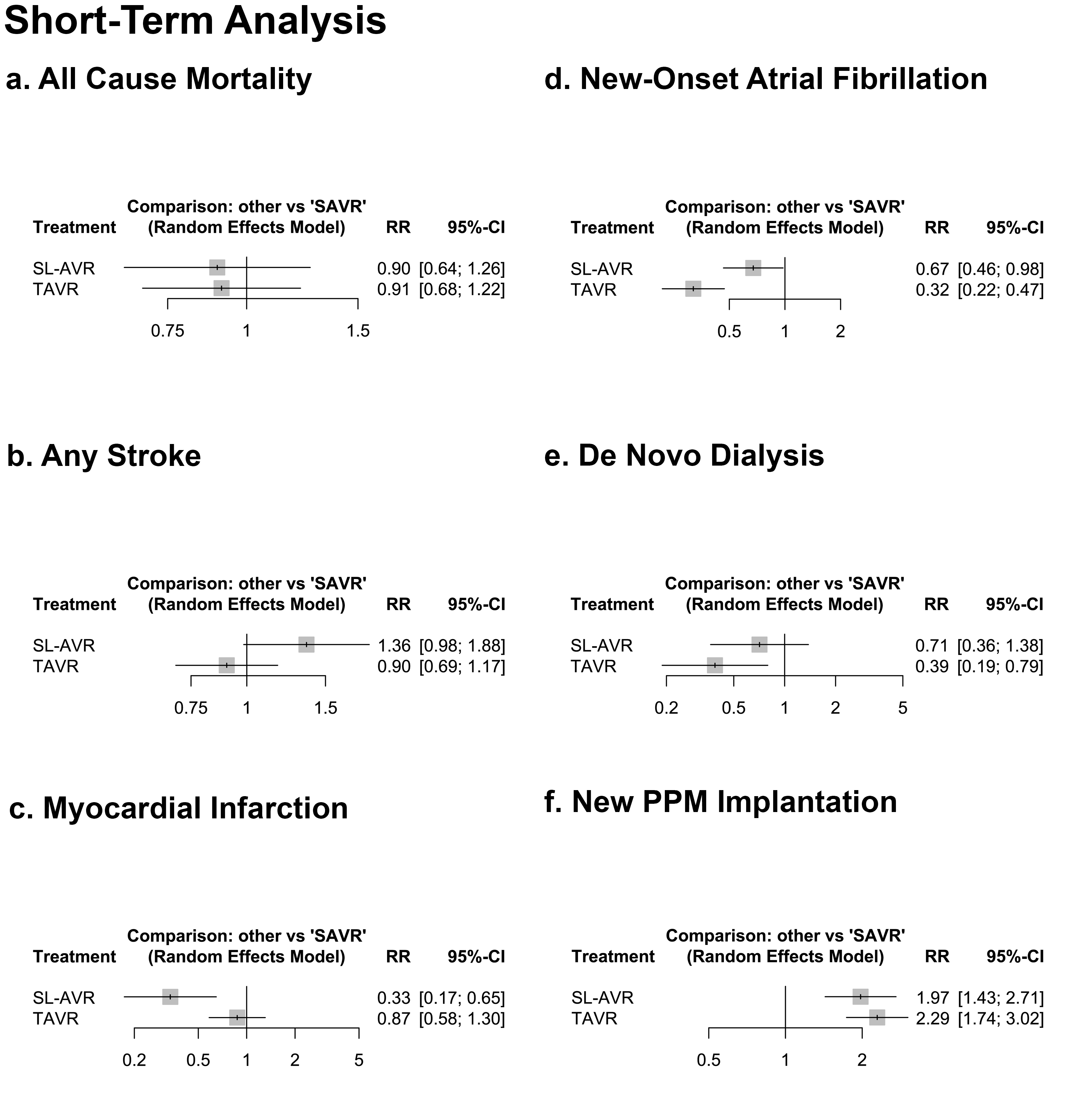
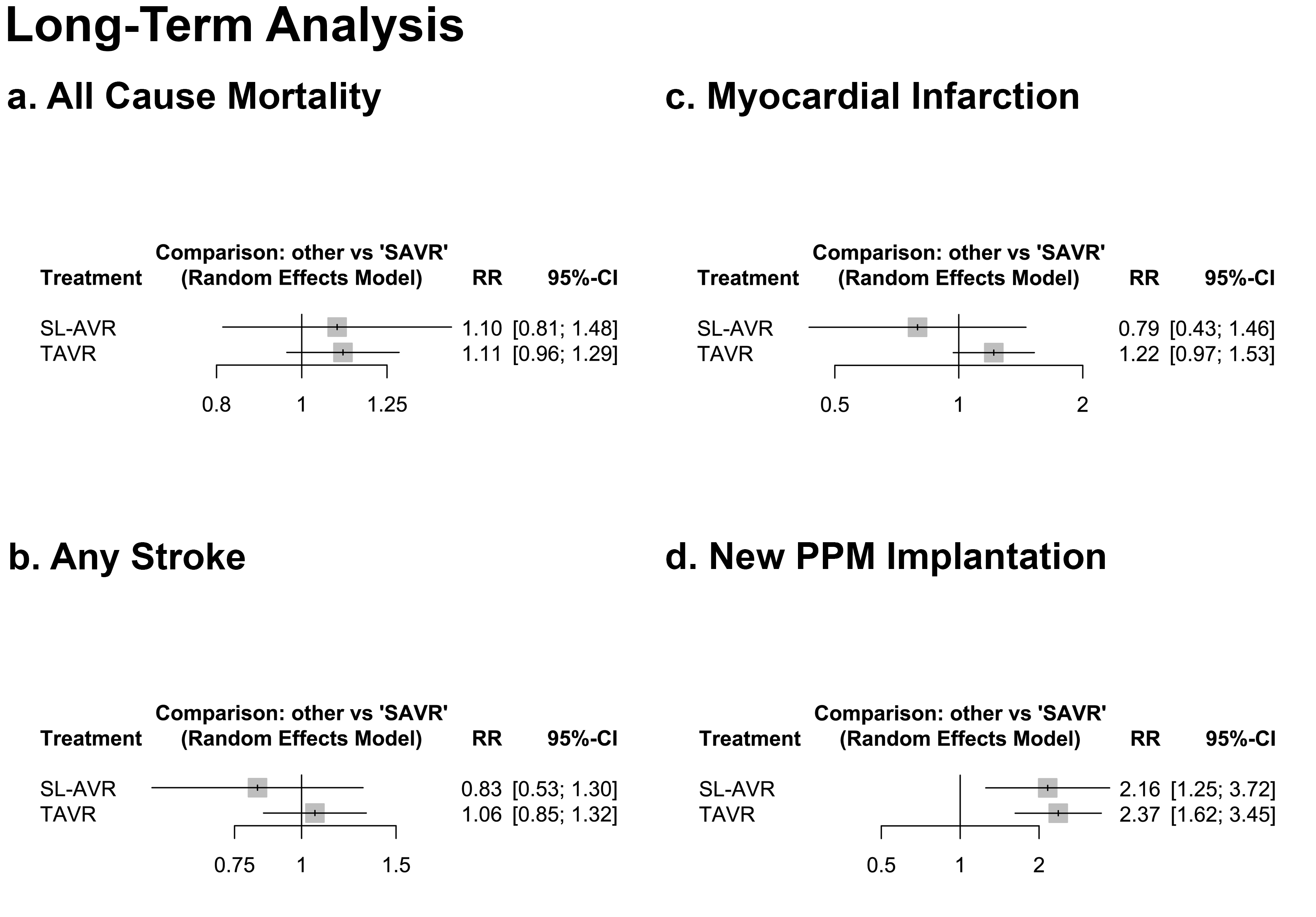
Thirty-six studies encompassing 29,701 participants (TAVR=9,443; SAVR=12,187; SL-AVR=8,071) were included. Insignificant differences were observed in short-term or long-term all-cause mortality (ACM) across interventions. SL-AVR demonstrated a significantly lower risk of myocardial infarction (MI) compared with TAVR (RR 0.14; 95% CI 0.05–0.42) but a higher risk of stroke compared to SAVR (RR 1.84; 95% CI 1.34–2.51). TAVR (RR 0.27; 95% CI 0.19–0.39) and SL-AVR (RR 0.81; 95% CI 0.76–0.88) were associated with a significantly lower risk of new-onset atrial fibrillation (AF) than SAVR. TAVR was also linked to a reduced risk of de novo dialysis compared with SAVR (RR 0.33; 95% CI 0.19–0.59). Conversely, both TAVR (RR 2.11; 95% CI 1.47–3.04; and RR 1.95; 95% CI 1.35–2.82) and SL-AVR (RR 1.95; 95% CI 1.65–2.31; and RR 1.95; 95% CI 1.35–2.82) were associated with higher rates of short-term and long-term permanent pacemaker (PPM) implantation compared with SAVR. Short-term analysis identified TAVR as the optimal treatment for stroke, new-onset AF, and de novo dialysis; SL-AVR for ACM and MI; and SAVR for PPM implantation. Long-term analysis indicated SL-AVR as optimal for stroke and MI, and SAVR for ACM and PPM implantation.

Conclusion

Minimally invasive procedures represent effective alternatives to conventional surgery for AVR in low-to-intermediate risk patients. However, both TAVR and SL-AVR are associated with an increased risk of conduction abnormalities, and SL-AVR additionally confers a higher risk of stroke.