Lots of interesting abstracts and cases were submitted for TCTAP 2026. Below are the accepted ones after a thorough review by our official reviewers. Don’t miss the opportunity to expand your knowledge!
ABS20250912_0001
Artificial Intelligence-Enabled Smart Glasses for Prehospital Emergency Care: Integrating Telemedicine and Wearable Monitoring
By Kirankumar Dyawarkonda
Presenter
Kirankumar Dyawarkonda
Authors
Kirankumar Dyawarkonda1
Affiliation
CDSIMER, India1
View Study Report
ABS20250912_0001
Digital Health and Artificial Intelligence
Artificial Intelligence-Enabled Smart Glasses for Prehospital Emergency Care: Integrating Telemedicine and Wearable Monitoring
Kirankumar Dyawarkonda1
CDSIMER, India1
Background
Prehospital emergency care is typically constrained by the inefficiency of time management, limited access to resources, and variability in the skill of providers. Clinical events in major trauma, out-of-hospital cardiac arrest, and acute ischemic stroke are subject to triage and delay in decision making, and under such circumstances, a minute at a time is an absolute morbidity and mortality determinant. New technologies in artificial intelligence (AI), wearable sensor-based biometric monitoring, and smart glasses, such as those with augmented reality capabilities, now hold the promise of transforming prehospital care into a real-time, integrated, and cognitively augmented environment. These technologies potentially fill existing gaps in the accuracy of diagnostics, the timeliness of therapeutics, and continuity of care, and thus attain optimized patient outcomes in a very wide range of emergencies.
Methods
We carried out a narrative synthesis through studies published between 2015 and 2024. Searches of PubMed, Scopus, and IEEE Xplore used combinations of keywords related to prehospital emergency care, tele-emergency medicine, wearable monitoring, and smart glasses.
Results
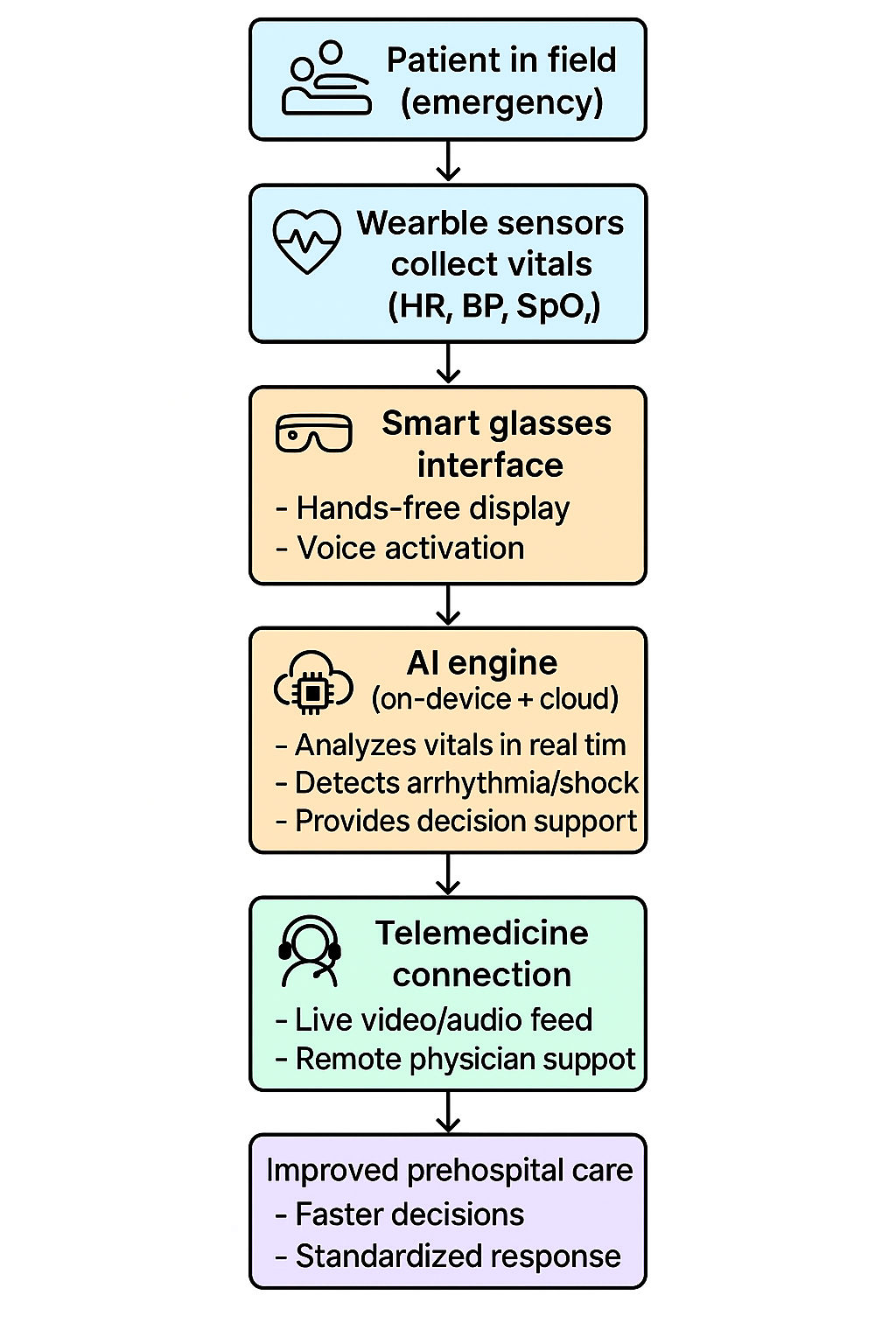
The implementation of smart glasses has solidified their promise of providing real-time video consults and enabling remote clinicians to provide more accurate guidance during resuscitation and sophisticated care for pre-hospital providers. The implementation of algorithm-directed Artificial Intelligence (AI)-led monitoring during the recognition of arrhythmias and during the prediction of hemodynamic instability implies the enhanced identification of deterioration at salient points. The simultaneous implementation of smart glasses and wearables provides streams of real-time physiological monitoring. In parallel, voice-dictation clinical notes, by virtue of AI-assisted natural language processing, reduce cognitive burden. Early pilots imply improved protocol compliance, reduced delay in decision making, and improved training for prehospital teams. Connectivity and safety of, and ergonomics in user design by reference to the implementation of complementary service provision within current emergency care workflows continue to raise concerns.
Conclusion
The smart glasses powered by artificial intelligence make a transformative leap for prehospital care in connecting first responders and high-level real-time analytics and knowledge, and closed remote real-time physician care networks. With wearable and remote integrated tech for real-time care monitoring, more promise exists for care variability reduction, refinement in executing important information, and emergency survival optimization in time-limited events. Future studies should include a stress on more high-scale population-based studies and research about cost-benefit and potential for smooth integration in heterogeneous emergency care systems