Lots of interesting abstracts and cases were submitted for TCTAP 2026. Below are the accepted ones after a thorough review by our official reviewers. Don’t miss the opportunity to expand your knowledge!
ABS20250709_0001
Impact of Colchicine on hs-CRP, Neutrophil Levels, Neutrophil-to-Lymphocyte ratio and Major Adverse Cardiac Events in Thai Patients With Acute Coronary Syndrome Undergoing PCI
By Wittawat Wattanasiriporn
Presenter
Wittawat Wattanasiriporn
Authors
Wittawat Wattanasiriporn1
Affiliation
Rajavithi Hospital, College of Medicine, Rangsit University, Thailand1
View Study Report
ABS20250709_0001
Pharmacotherapy (Coronary)
Impact of Colchicine on hs-CRP, Neutrophil Levels, Neutrophil-to-Lymphocyte ratio and Major Adverse Cardiac Events in Thai Patients With Acute Coronary Syndrome Undergoing PCI
Wittawat Wattanasiriporn1
Rajavithi Hospital, College of Medicine, Rangsit University, Thailand1
Background
Acute coronary syndrome (ACS) a spectrum of conditions resulting from the rupture of atherosclerotic plaques and subsequent thrombosis. Inflammation is a critical component in the pathogenesis of ACS. Elevated levels of high sensitivity C-reactive protein (hs-CRP), Neutrophil levels and Neutrophil-to-Lymphocyte ratio (NLR) have been associated with poorer outcome, suggesting that targeting inflammation may improve clinical results. Colchicine has been shown potential benefits in reducing inflammatory markers in cardiovascular events and hs-CRP level. However, currents clinical guidelines have not yet established colchicine as a standard treatment in ACS undergoing PCI.
Methods
A single-center, retro-prospective observational cohort study conducted at Rajavithi between 1 January 2024 to 31 December 2024. Enrolled ACS patients who have undergone PCI within 45 days of diagnosis. Patients receiving colchicine 0.6 mg per day as part of their treatment will be compared to a control group receiving standard care. Hs-CRP levels will be measured at baseline, 1 and 3 months, alongside monitoring clinical outcomes and other relevant variables.
Results
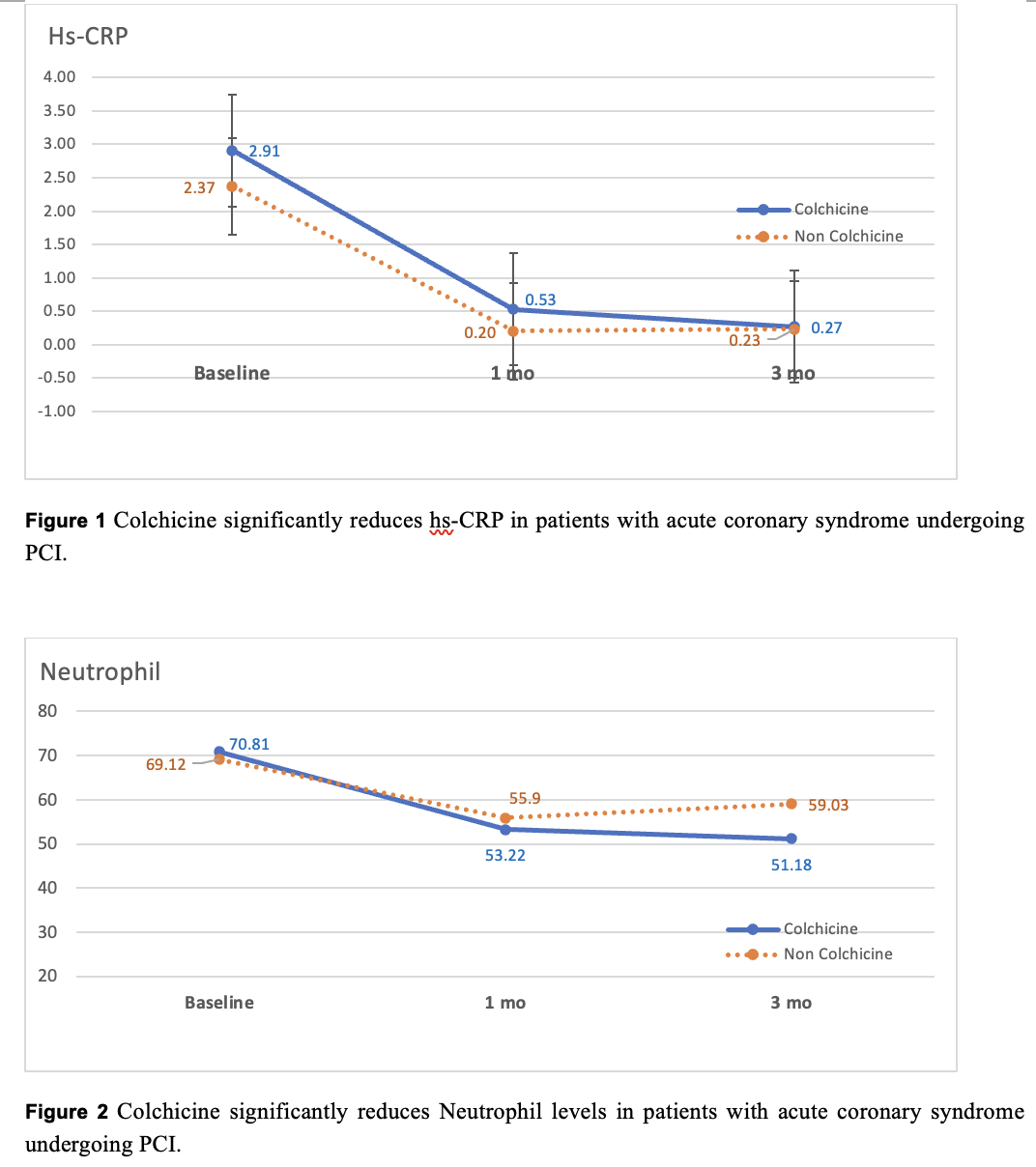
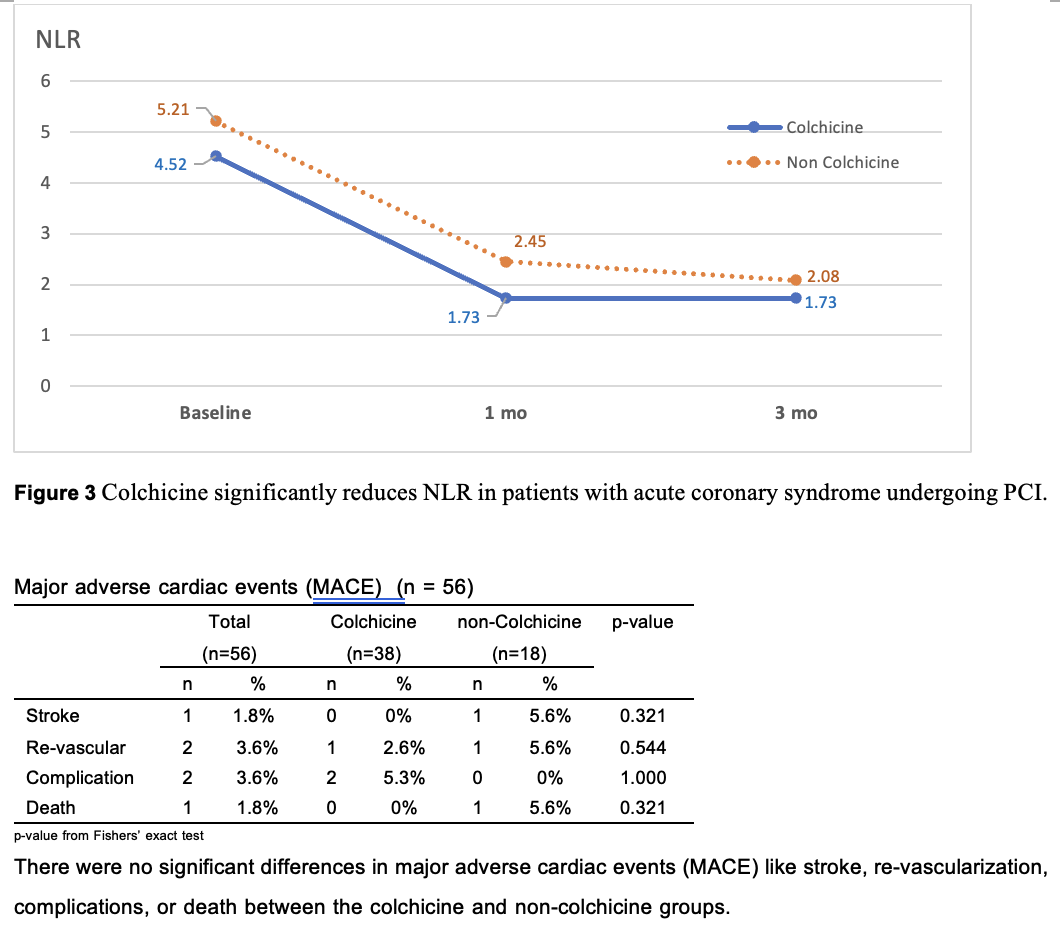
Total 56 patients were enrolled. The observational reduction in hs-CRP levels (2.29±3.37 vs. 0.45±1.03, p=0.044) indicates that colchicine effectively reduces inflammation in this patient population. Similarly, Neutrophil counts and Neutrophil-Lymphocyte ratio (NLR) showed a significant reduction in the colchicine group compared to the non-colchicine group 21.86±10.62 vs. 4.13±12.92, p=0.001 and 2.98±2.93 vs. 1.68±3.60, p=0.025 respectively. There were no significant differences in MACE.
Conclusion
Colchicine significantly reduces hs-CRP, neutrophil levels and NLR in patients with acute coronary syndrome undergoing PCI. NLR levels are positively correlated with hs-CRP level and the severity of ACS, and can be used as a predictor of the inflammatory marker of ACS patients. These findings highlight colchicine's potential to modulate systemic inflammation and its possible cardioprotective benefits. However, the absence of significant differences in clinical outcomes such as mortality and stroke may be attributed to the study's limited sample size and short follow-up duration.